Context
Shinken Entreprise installation
Prerequisites
Required environment: RHEL/Centos 6.6, 7.2, 7.3, 7.4, 7.5 and 7.6 [ 64bits ]
Shinken Enterprise chose Linux distributions produced by RedHat: Red Hat Enterprise Linux (RHEL) and CentOS (Community enterprise Operating System). These linux distributions, mainly designed for servers are stable, performant and compatible with a vast majority of professional environments. The CentOS is also very performant (based on the commercially distributed RHEL).Warning- Redhat registration
When installation a RedHat Enterprise Linux (commercial distribution, you must attach your RedHat subscription to your system.
Here are the commands to use on your server:
Voici les commandes à utiliser depuis le serveur:
1/ subscription-manager register
(-> username / password)You also need to attach your subscription to the current OS:
2/ subscription-manager attach
Yum can now be used because the subscription is valid (and Shinken will be able to be installed).
Package extraction and installation
Automatic installation:
- Extract the delivery package :
- tar zxvf shinken-enterprise_V02.05.XXX-LANGUAGE.tar.gz
- This will create a new directory containing the installation script and dependencies required for the installation.
Move to the shinken-entreprise directory (cd shinken-enterprise_V02.05.XXX-LANGUAGE) and execute the script :
- Extract the delivery package :
./install.sh
- This will automatically install Shinken Enterprise and its components
- However, the VMWare SDK will require a manual install.
- The commands to type to launch the VMWare DSK installation are displayed at the end of the installation process:
- This will automatically install Shinken Enterprise and its components
Please launch:
/tmp/shinken-enterprise_V02.05.XXX-LANGUAGE/tools/install-vmware-sdk.sh
And follow the instructions in order to install it and allow VMWare communication
We advise to execute these commands directly, but they can also be performed later if needed.
Checking your Shinken Enterprise installation
- Check the installation:
- To check if Shinken Enterprise has been installed correctly, launch the following command :
- To check if Shinken Enterprise has been installed correctly, launch the following command :
shinken-healthcheck
A warning is issued as expected to say the Shinken Enterprise license key is not installed. Head over to the License key section further down on this page to install your license key.
The installation process will perform on the server:
- The installation of the Shinken Enterprise engine, modules and dependencies
- The activation of all daemons (Synchronizer, Arbiter, Scheduler, Poller, Reactionner, Broker, Receiver).
For a distributed installation, see the Distributed architecture page.
Web interfaces access
Configuration UI
Once Shinken Enterprise installed, the Configuration UI can be accessed via a web browser at the address displayed during the installation:
- By default, the Configuration UI is available via the 7766 port (HTTP protocol). For instance: http://192.168.0.1:7766
The IP address (or FQDN if your name resolution is configured) corresponds to the server hosting the Synchronizer daemon.
See the Configuration UI page for more information.
Visualization UI
Once Shinken Enterprise installed, the Configuration UI can be accessed via a web browser at the address displayed during the installation:
- By default, the Configuration UI is available via the 7767 port (HTTP protocol). For instance: http://192.168.0.1:7767
The IP address (or FQDN if your name resolution is configured) corresponds to the server hosting the Broker daemon.
See the Visualization UI page for more information.
User guide available in the installation package
The user guide (in French) is now included in the installation package.
You can find it in: shinken-enterprise_V02.05.XXX-LANGUAGE.tar.gz/tools/documentation/ui-visualization/
All you need is for a user, via his or her web browser, to open the "index.html" file in order to be able to browse the user guide, which contains the documentation related to the visualization IU.
Installation (advanced mode)
- Automatic partial installation (only enables selected daemons):
- Extract the package archive
- tar zxvf shinken-enterprise_V02.05.XXX-LANGUAGE.tar.gz
- This will create a new directory containing the installation script and dependencies required for the installation.
Move to the shinken-entreprise directory (cd shinken-enterprise_V02.05.XXX-LANGUAGE) and execute the install.sh script, passing the following options based on the daemons you want to enable:
--pollernode: Enables the Poller daemon (responsible for check execution)
--reactionnernode: Enables the Reactionner daemon (responsible for notifications and event handlers)
--schedulernode: Enables the Scheduler daemon (responsible for the planification of the checks execution)
--arbiternode: Enables the Arbiter daemon (responsible for the central distribution of configuration and informations)
--receivernode: Enables the Receiver daemon (responsible for receiving results for passive checks)
--synchronizernode: Enables the Synchronizer daemon (responsible for configuration management)
--brokernode: Enables the Broker daemon (responsible for presenting the checks results and data the the world: Visualization UI, SLA)
- Extract the package archive
Exemple
You can for example install Shinken Enterprise and enable only the Scheduler and Pollers daemons by launching the command:
./install.sh --schedulernode --pollernode
- To check that the selected daemons are up to date, correctly configured and running, launch the following command:
shinken-healthcheck
The shinken-healthcheck checks that Shinken Enterprise configuration is correct and coherent, and is running (only for enabled daemons)
- After the initial installation, if you want to enable/disable daemons, use the activation commands detailed in the TODEL Daemons listing/enable/disable page.
- When updating, the update.sh scripts updates all daemons, even if they are disabled. Their enabled/disabled state will be kept intact.
The different addons are automatically enabled during the installation:
- nagvis-shinken-architecture: Enabled on installations with an Arbiter enabled (more details in the dedicated documentation page: Activation et configuration de la fonctionnalité)
- nagvis: Enabled on installations with an Broker enabled (more details in the dedicated documentation page: NagVis ( Addon ))
Enabling data encryption
You can enable Chiffrement des données sensibles automatically when launching the installation.
If you never enabled the automatic encryption of sensible data, we advise to proceed to the normal installation and enabled data encryption manually after having read the Chiffrement des données sensibles documentation page.
An encryption key is generated during the installation and the Synchronizer database will be encrypted.
To enable this feature, launch the following command:
./install.sh --activate-encryption <nom de clé> --disable-important-notices-user-input
- The --activate-encryption parameter enables the encryption: the key name is optionnal; it will be asked during the installation process if not specified in the parameter.
- The--disable-important-notices-user-input parameter disables interactive prompts during the installation process.
Enabling the automatic encryption of sensitive data requires to export and save the encryption key generated during the process. Please consult shinken-protected-fields-keyfile-export for more informations.
The shinken-healthcheck can be used to check the daemons configuration and encryption status.
Updating Shinken Enterprise
Prerequisites
- Environment : RHEL/Centos 6.6, 7.2, 7.3, 7.4, 7.5 and 7.6 [64bits] with a previous Shinken Enterprise version installed.
Package extraction and updates
- Updating:
- Extract the package archive
- tar zxvf shinken-enterprise_V02.05.XXX-LANGUAGE.tar.gz
- This will create a new directory containing the installation script and dependencies required for the installation.
- Move into the shinken-entreprise folder (cd shinken-enterprise_V02.05.XXX-LANGUAGE) and execute the script :
- Extract the package archive
./update.sh
- This script updates Shinken Enterprise but does not overwrite files in /etc/shinken, avoiding overwriting configuration defined by the Shinken administrator. Instead of overwriting your configuration files, "*.rpmnew" files are added, that may contain new configuration properties. It is advised to check these files after updating to report possible new features in your existing configuration files.
- Before updating, a backup of configuration and user data is done and placed into /tmp. These backup follow the following naming convention: "backup-preupdate-version-NUMERO_VERSION"
In case of an error during the update, the update.sh script may stop so that you can fix the problem. The most common errors are as follows:
| Problème | Solution | |
|---|---|---|
| 1 | The update.sh script fails to connect to the Mongo database | Check that it is started:
Restart mongod if the daemon is stopped
|
| 2 | The update.sh script indicates that two elements with the same name exist in the database. The error message lists the elements with the same name. | Delete or rename one of the two elements whose name is indicated |
En cas de doute, n'hésitez pas à contacter votre support.
Checking your Shinken Enterprise installation
- The shinken-healthcheck tool can be used to check daemons configuration and running state:
- The shinken-healthcheck tool can be used to check daemons configuration and running state:
shinken-healthcheck
Updating configuration objects via the cfg-file-shinken source
During Shinken Enterprise installation, lots of checks (via Packs Shinken, Linux, Windows,.. templates) are imported in the Configuration UI. These elements, grouped into packs, are available and importedusing the "cfg-file-shinken" source.

When updating, these elements may be updated, but these changes are not automatically integrated into your monitoring configuration to avoid unintentional behaviour or breaking changes. To see the changes, make sure the "cfg-file-shinken" source is enabled and import the source. The changed elements will appear with the "New" of "Difference" status.
If you made changes on elements of these pacjs, be careful before applying differences because your changes could be overwritten or lost.
However, it is strongly advised to systematically update at least the elements of the Shinken pack (new and differences).
Shinken Enterprise license key
Once Shinken Enterprise is installed, the shinken-healthcheck command launched from the server hosting the Arbiter daemon displays an error message concerning your license. The default license is a trial license, limited to 20 hosts.

The Shinken Enterprise commercial service should have sent a nominative license allowing you to use the product to its full potential.
The license is a file name user.key, nominative and limite in time.
To install it:
- Copy this file on the Arbiter server to /etc/shinken/user.key
- Restart Shinken Enterprise: /etc/init.d/shinken restart
Relaunch the shinken-healthcheck command. The error message concerning the license should have disappeared to be replaced with an informative text about your license;

If you don't have a license key or if your license key has expired, contact us: contact@shinken-solutions.com
Troubleshooting installation/update issues
When installing dependencies, if a machine is not connected to the Internet or connected to a repository access, installation or update scripts may fail.
In this case, files are created in the user's home with whom the installation/update is performed. These files contain more details about the errors encountered and can be sent to your Shinken Enterprise support contact for correction:
- ~/shinken.enterprise.enterprise.install.log
- ~/shinken.enterprise.enterprise.install.detail.log
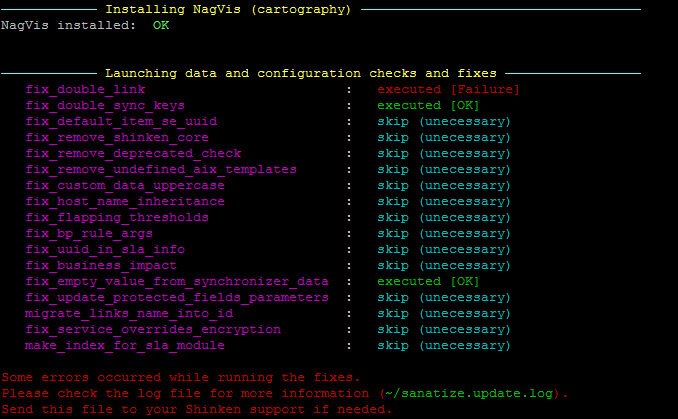
- ~/sanatize.update.log
- ~/shinken.enterprise.update.log