...
Rôle
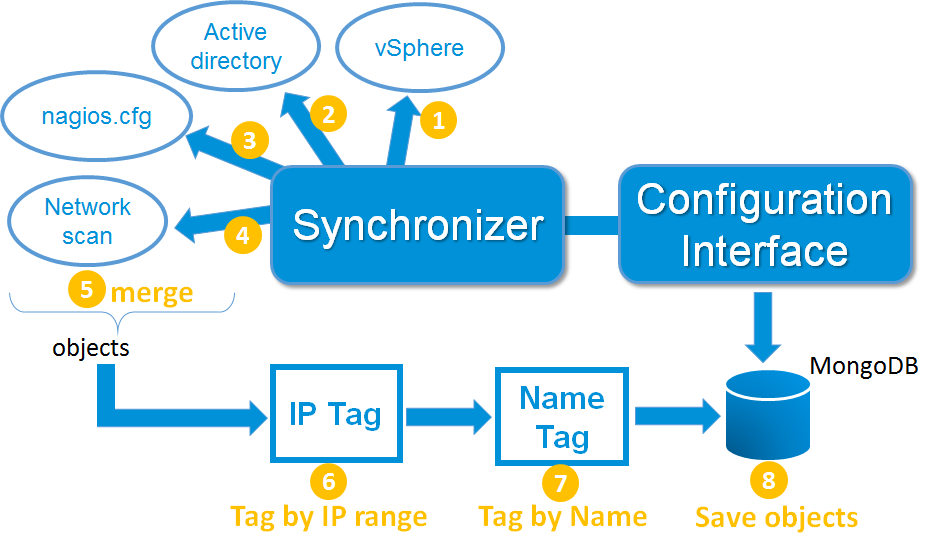
The synchronizer daemon manages the whole configuration. It uses sources to detect new hosts and host modifications.
Le synchronizer gère toute la configuration. Il utilise différentes sources pour détecter les nouveaux éléments ou les modifications sur les existants.
Il présente la configuration en interface web aux administrateurs. Voici les sources optionnelles que le démon peut utiliserIt presents the configuration web interface to the administrators. Here are the optional sources the daemon can use to get information:
- Active directory
- VSphere (VMWare)
- Fichiers de configuration Nagios or ou Shinken framework configuration filesframework
- Scans réseauNetwork scans
Active directory
The Active Directory discovery is done with a domain account, and only need a read access. The connexion can be done in LDAPS to be sure the connexion is secure.
It is possible to define a top level OU in order to list only the elements (servers and users) that are defined below this OU level.
The information that the module is getting are server names, FQDN, the server OS, and if defined in the LDAP entry, its localization. The configuration for this source is located in another page.
VSphere from VMWare
The VSphere discovery is designed to discover physical servers (ESX) and their virtual servers. It will also get OS and their IP address, but only if the VMware tools are enabled and running on the virtual server.
The Synchronizer to VMware connexion is always through the VSphere server, and needs a read access only . The Shinken Enterprise servers do not need any direct access to the ESX servers.
The Shinken Enterprise to VSphere communication is done with the SOAP API from VMWare, onto an HTTPS connexion. The configuration for this source is located in another page.
Nagios or Shinken Framework configuration files
Shinken Enterprise is able to load any Nagios or Shinken Framework configuration files. It will automatically load the defined objects into its configuration. The configuration for this source is located in another page.
Network scans
The network scan discovery is optional. It's done thanks to the nmap command, launched on the Synchronizer server. It allows to scan networks defined by the Shinken Enterprise administrators.
The scans are done on the TCP and UDP ports. It will also try to get additionnal data from the servers and services running on them (it use the -O option of the nmap command). The configuration for this source is located in another page.
Data storage of the configuration
All discovered data from the Synchronizer are saved into a Mongodb database. If possible, it's better for the database to be set aside the Synchronizer daemon. this database do not need to be shared with other daemons, and so its communications should be limited to the local synchronizer server.
Configuration interface and its access
The configuration interface is hosted on the Synchronizer daemon, and use another TCP port than the visualization UI. You can use two different credential systems:
- Manage directly on the configuration interface
- Manage credentials with Active directory accounts. the daemon will use Ldap connexions to check for the credentials.
The non-admon users will be restricted in the visibility onto the hosts they are direct contacts linked to, or are in a contact group linked with the hosts.
This interface is using the save Mongodb databse than the synchronizer daemon. The default port for this configuration interface is 7766.
La découverte de l'Active Directory se fait avec un compte domaine, ne nécessite qu'un accès en lecture. La connexion peut être faite dans LDAPS pour être sûr que la connexion est sécurisée.
Il est possible de définir un niveau haut d'organisation (OU = Organizational Unit) afin de lister les éléments seulement sous ce niveau .
Les informations que ce module récupère sont les noms de serveurs, FDQN, l'OS du serveur , et si il est défini, son entrée LDAP et son emplacement. La configuration pour cette source est située dans une autre page.
VSphere de VMWare
La découverte VSphere est faite pour trouver les serveurs physiques (ESX) et leurs serveurs virtuels. Elle va également récupérer leur OS et leur adresse IP , mais seulement si les outils VMware sont activés et tournent sur le serveur virtuel.
La connexion du Synchronizer vers VMware connexion se fait toujours vis le serveur VSphere ,et ne nécessite qu'un accès en lecture. Le serveur Shinken Enterprise ne nécessite pas un accès direct aux serveurs ESX .
La communication de Shinken Enterprise vers VSphere se fait via une API SOAP de VMWare, à travers une connexion HTTPS . La configuration pour cette source est située dans une autre page.
Fichiers de configuration Nagios ou Shinken Framework
Shinken Enterprise est capable de charger des fichiers de configuration Nagios ou Shinken Framework. Il va automatiquement chargés les objets définis. La configuration pour cette source est située dans une autre page.
Scan réseau
La découverte vis scan réseau est optionnelle. Elle se fait via une commande nmap ,lancée par le Synchronizer.
Les scans sont faits sur les ports TCP et UDP .Il va également essayer de récupérer des données complémentaires depuis les serveurs ou le services qui tournent dessus (il utilise l'option -O dans la commande nmap ). La configuration pour cette source est située dans une autre page.
Stockage de données dans la configuration
Toutes les données découvertes par le Synchronizer sont stockées dans une base Mongodb .Si possible, il est préférable que la base soit à côté du Synchronizer , elle n'a pas besoin d'être partagée par d'autres démons, donc ses communications doivent être limitées su serveur local.
Configuration de l'interface et de ses accès
L'interface de configuration est stockée par le Synchronizer ,et utilise un autre port TCP pour l'UI de visualisation. Vous pouvez utiliser 2 systèmes d'accrédidation:
- gestion directe dans l'interface de configuration
- gestion des droits avec les comptes Active directory . Le démon va alors utilisé les connexions Ldap pour vérifier les autorisations.
Les utilisateurs non-admin auront une visibilité restreinte sur les hôtes auxquels ils sont attachés directement, ou au groupe auquel ils sont rattachés.
Cette interface utilise la même base Mongodb que le synchronizer . Le port par défaut est le 7766.
| Interface | Démon | Interface | Daemon | Port |
|---|---|---|---|---|
| Configuration | Synchronizer | 7766 |
Résumé des connexions du Synchonizer
...
| Source daemon | Connexion toà | Port | ProtocolProtocole | Note |
|---|---|---|---|---|
| Synchronizer | Active Directory | 636 | LDAPS | Read only account |
| Synchronizer | VSphere | 443 | HTTPS | Read only account on VSphere |
Variable Descriptions
| Property | Default | Description |
|---|---|---|
| synchronizer_name | N/A | This variable is used to identify the *short name* of the synchronizer which the data is associated with. |
| address | N/A | This directive is used to define the address from where the main arbier can reach this synchronizer. This can be a DNS name or a IP address. |
| port | 7765 | This directive is used to define the TCP port used by the daemon. |
| spare | 0 | This variable is used to define if the synchronizer must be managed as a spare one (will take the conf only if a master failed). The default value is *0* (master). |
| modules | N/A | This variable is used to define all modules that the synchronizer will load. |
| sources | N/A | List of sources that the synchronizer will load. |
| taggers | N/A | List of taggers that the synchronizer will load. |
Example Definition
| Code Block |
|---|
define synchronizer {
    synchronizer_name      synchronizer-master
    #host_name             node1       ; CHANGE THIS if you have several Arbiters
    address                localhost   ; DNS name or IP
    port                   7765
    spare                  0           ; 1 = is a spare, 0 = is not a spare
    modules                Cfg_password
    use_ssl                0
    sources                syncui,cfg-file-shinken,active-dir,sync-vmware,cfg-file-nagios,discovery
    taggers                ip-tags,regexp-tags
} |