Qu'est-ce qu'un cluster? | |||||||||||||||||||||||||||||||||||||||
Son rôle principal est de permettre d'avoir dans un seul indicateur l'état agrégé d'autres états. Cet indicateur propose une vue unique pour des utilisateurs jouant différents rôles. Rôles typiques | |||||||||||||||||||||||||||||||||||||||
What is a cluster? | |||||||||||||||||||||||||||||||||||||||
The main role of this feature is to allow users to have in one "indicator" the aggregation of other states. This indicator can provide a unique view for users playing different roles. Typical roles:
Let's take a simple example of a service delivery role for an ERP application. It mainly consists in the following IT componentsPrenons l'exemple d'un rôle de service delivery pour une application ERP . Il est principalement constitué de:
These IT components (Hosts in this example) will be the basis for the ERP service. With business rules, you can have an "indicator" representing the "aggregated" state for the ERP service! Shinken Enterprise already checks all of the IT components one by one including processing for root cause analysis from a host and service perspective. | |||||||||||||||||||||||||||||||||||||||
Accessing Cluster Configuration | |||||||||||||||||||||||||||||||||||||||
Ces composants (Hôtes dans cet exemple) seront la base de ce service ERP . Avec des règles métier, vous pouvez avoir une vue agrégée de l'indicateur représentant l'état du service ERP ! Shinken Enterprise vérifie chaque composant un par un pour l'analyse de problème source. . | |||||||||||||||||||||||||||||||||||||||
Accéder à la configuration du Cluster | |||||||||||||||||||||||||||||||||||||||
Accès par le menu principal Clusters Configuration can be accessed by the Main Menu "Elements". 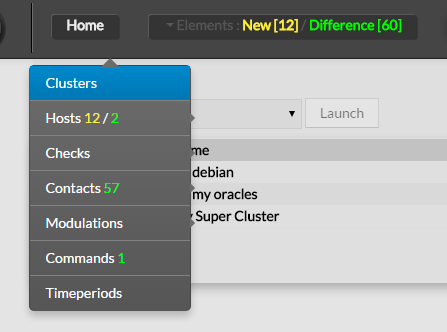 | |||||||||||||||||||||||||||||||||||||||
How to define Comment définri les Clusters | |||||||||||||||||||||||||||||||||||||||
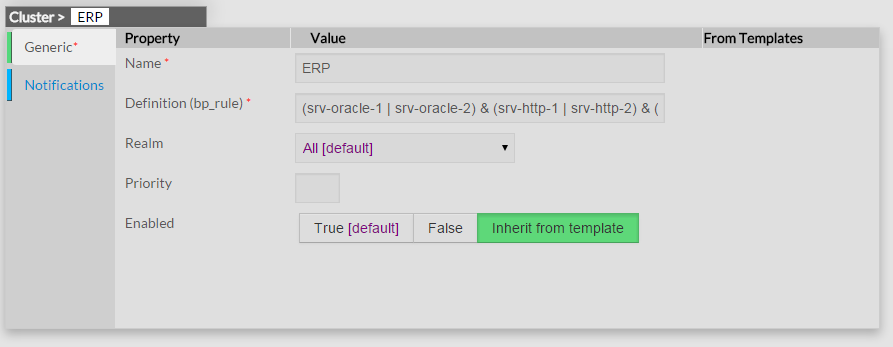
Here is a configuration for a sample ERP ruleExemple de configuration d'une règle ERP :
| |||||||||||||||||||||||||||||||||||||||
Notification logic | |||||||||||||||||||||||||||||||||||||||
| A Cluster have the same notification logic than the hosts. This means you can have contacts that will receive only the relevant notifications based on their role. | |||||||||||||||||||||||||||||||||||||||
With "need at least X elements" clusters | |||||||||||||||||||||||||||||||||||||||
Logique de notification | |||||||||||||||||||||||||||||||||||||||
| Un Cluster a la même logique de notification que les hôtes. | |||||||||||||||||||||||||||||||||||||||
Avec "nécessite au moins " X éléments" clusters | |||||||||||||||||||||||||||||||||||||||
Dans certains cas, un cluster de N éléments nécessite d'avoir au moins X d'entre eux en état OK pour tourner. C'est facilement paramétrable, il suffit d'utiliser l'opérateur In some cases, you know that in a cluster of N elements, you need at least X of them to run OK. This is easily defined, you just need to use the "X of:" operator . Here is an example of the same ERP but with Voici un exemple avec 3 http web servers, and you need at least 2 of them (to handle the load)et au moins 2 d'entre eux en état OK :
| |||||||||||||||||||||||||||||||||||||||
Possible values of X in X of: expressions | |||||||||||||||||||||||||||||||||||||||
The X of: expression may be configured different values depending on the needs. The supported expressions are described below:
| |||||||||||||||||||||||||||||||||||||||
The NOT rule | |||||||||||||||||||||||||||||||||||||||
You can define a not state rule. It can be useful for active/passive setups for example. You just need to add a ! before your element name. Aggregated state will be ok if database1 is UP and database2 DOWN on this example.
| |||||||||||||||||||||||||||||||||||||||
Grouping expression expansion | |||||||||||||||||||||||||||||||||||||||
Sometimes, you do not want to specify explicitly the hosts contained in a business rule, To do so, it is possible to use a *grouping expressionwhich is expanded into hosts or services. The supported expressions use the following syntax:
The flag is a single character qualifying the expansion type. Host flags
Check flags
Examples of combined expansion expressionYou want to build a business rule including all web servers composing the application frontend.
which is equivalent to:
You may obviously combine expression expansion with standard expressions.
which is equivalent to:
| |||||||||||||||||||||||||||||||||||||||
...