...
Shinken Enterprise regardent toutes les relations et créée un graphe avec. Un graphe est une partition de relations.
Illustration :
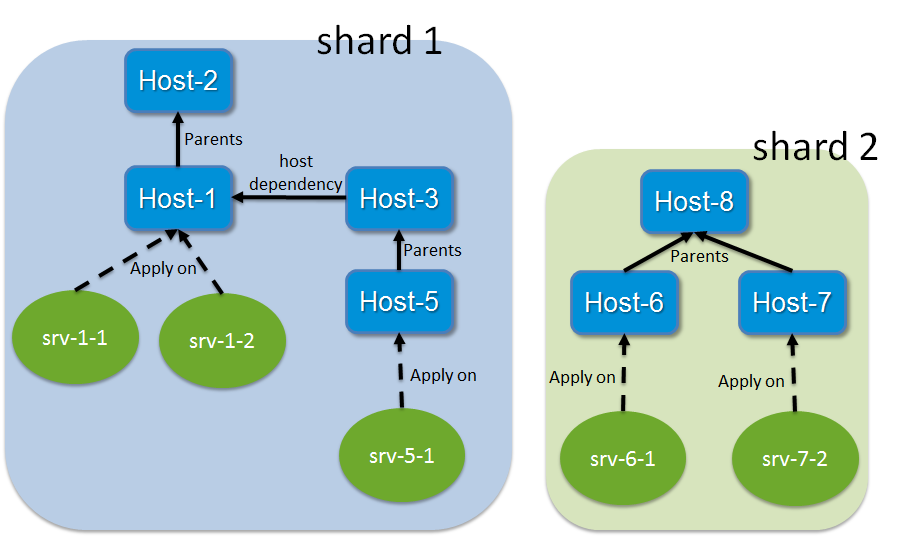
In this example, we will have two shards:
Dans cet exemple, nous avons 2 partitions:
- Shard shard 1: Host-1 to au host-5 and all their et tous leurs checks
- shard Shard 2: Host-6 to au Host-8 and all their checks
The shards aggregations into scheduler configurations
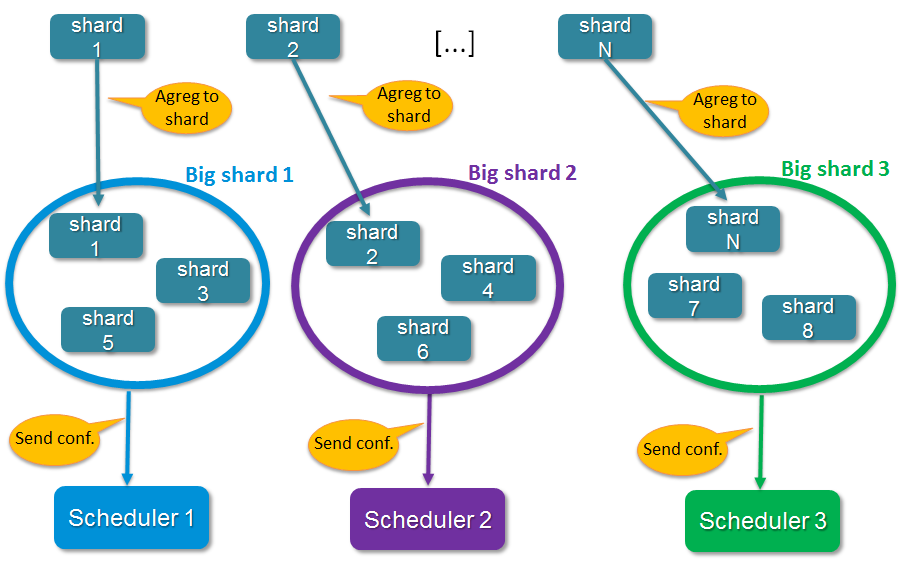
When all relation shards are created, the Arbiter aggregates them into N configurations if the administrator has defined N active schedulers (no spares). shards are aggregated into configurations (it's like "Big shards"). The dispatch looks at the weight property of schedulers: the higher weight a scheduler has, the more shards it will have. This can be shown in the following picture :
The configurations sending to satellites
- et tous leurs checks
L'aggrégation des partitions dans les schedulers
Quand toutes les partitions sont créées, l'Arbiter les agrègent dans N configuration si l'administrateur a défini N Schedulers actifs (sans spare).
La répartition se fait sur un critère de poids des Schedulers : plus le poids est élevé, plus il y a de packs .
Illustration :
Envoi des configurations vers des satellites
Une fois que toutes les configurations sont créées, l'Arbiter les envoie aux N Schedulers actifs .
Un Scheduler peut commencer à lancer des checks une fois qu'il reçu et chargé sa configuration sans avoir à attendre que TOUS les Schedulers soient prêts.
Pour des configurations plus importantes, avoir plusieurs Schedulers (même sur un seul serveur) est fortement recommandé car ils chargeront leur configuration beaucoup plus vite (nouvelle ou modification)
L'Arbiter crée également les configurations pour ses satellites (pollers, reactionners et brokers) avec les liens permettant de savoir où réaliser les tâches .
Après avoir envoyé les configurations, l'Arbiter commence à traiter les ordres (appelées commandes externes) des utilisateurs et est responsable de vérifier la disponibilité des satellites.
When all configurations are created, the Arbiter sends them to the N active Schedulers. A Scheduler can start processing checks once it has received and loaded it's configuration without having to wait for all schedulers to be ready(v1.2). For larger configurations, having more than one Scheduler, even on a single server is highly recommended, as they will load their configurations(new or updated) faster. The Arbiter also creates configurations for satellites (pollers, reactionners and brokers) with links to Schedulers so they know where to get jobs to do. After sending the configurations, the Arbiter begins to watch for orders from the users and is responsible for monitoring the availability of the satellites.
Pollers connections with more than one scheduler
...