Role
The arbiter daemon reads the configuration from the synchronizer. It divides it into Le démon arbiter lit la configuration du synchronizer. Il la divise en N parts (N schedulers = N parts), and distributes them to the appropriate et les distribue au démon Shinken Enterprise daemons. Additionally, it manages the high availability features: if a particular daemon dies, it re-routes the configuration managed by this failed daemon to the configured spare. Finally, it receives input from users or passive check results and routes them to the appropriate daemon. Passive check results are forwarded to the Scheduler responsible for the check. There can only be one active arbiter with other arbiters acting as hot standby spares in the architecture.
Connexion with the synchronizer
approprié. Il gère également la notion de haute disponibilité : si un démon en particulier meurt, il renvoie la configuration gérée par le démon mort à son spare défini qui reçoit les informations des utilisateurs ou les résultats de checks passifs et les routent vers le démon approprié . Les résultats de checks passifs sont renvoyés au Scheduler responsable du check. Il ne peut y avoir qu'un seul arbiter actif avec les autres arbiters jouant le rôle de spare en standby
Connexion avec le synchronizer
La communication entre l'arbiter et le synchronizer est faite sur le port standard du The communication between the arbiter and the synchronizer is done on the standard port of the synchronizer (7765).
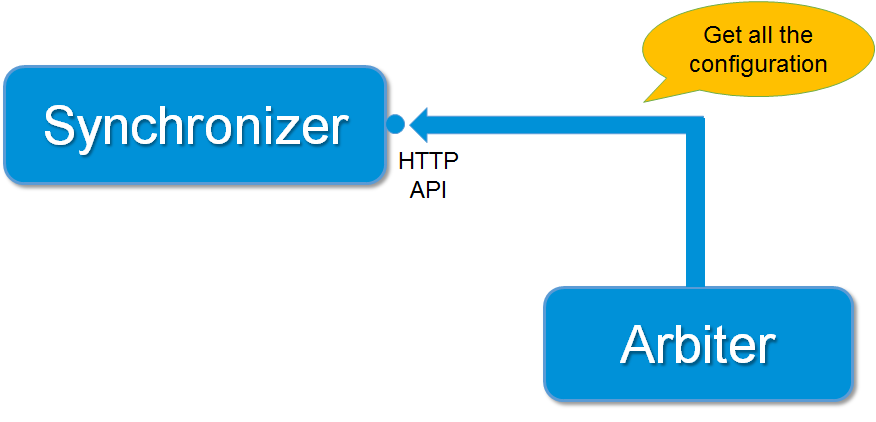
Connexion
...
This daemon is used to check and dispatch configuration to the other daemons, but not to the Synchronizer. The connexion is done on the standard port of the other daemons, and will use a HTTPS connexion if the other daemons are defined to use it.
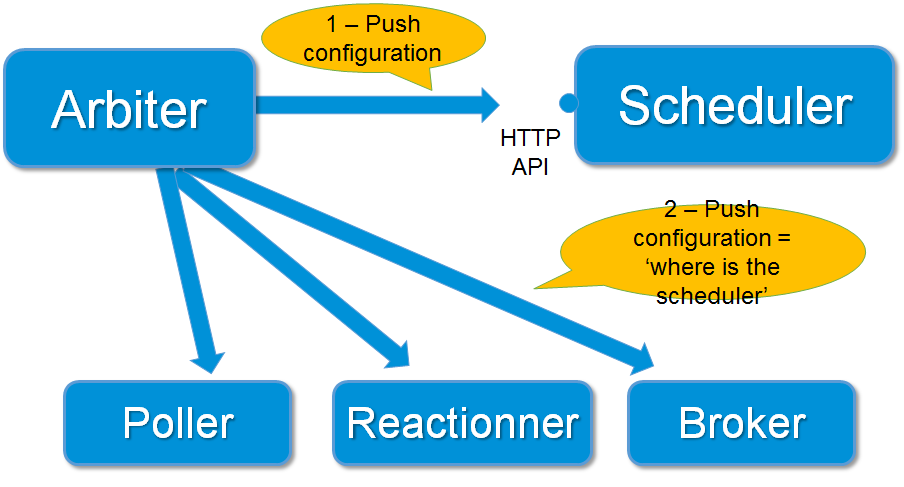
Data
This daemon is hosting the whole system configuration into memory. It has access to all server names, address, types, and also the defined command used to check them.
It also hosts in memory the defined contacts that should receive notification for the defined hosts and services.
Arbiter connexion summary
avec les autres démons
Ce démon est utilisé pour vérifier et distribuer la configuration aux autres démons, sauf au Synchronizer. Il se connecte sur le port standard des autres démons, et utilise une connexion HTTPS si ceux-ci l'ont prévu.
Données
Ce démon stocke la totalité du système de configuration en mémoire. Il a accès à tous les noms de serveurs, adresse, type et commande définis pour les vérifier.
Il stocke également en mémoire les contacts définis, qui doivent recevoir les notifications pour les hôtes et services définis.
Résumé des connexions de l'Arbiter
| Démon source | Destination | Port | Protocole |
|---|
| Note | ||||
|---|---|---|---|---|
| Arbiter | Synchronizer | 7765 | HTTPS | |
| Arbiter | Scheduler | 7768 | HTTPS | |
| Arbiter | Poller | 7771 | HTTPS | |
| Arbiter | Reactionner | 7769 | HTTPS | |
| Arbiter | Receiver | 7773 | HTTPS | |
| Arbiter | Arbiter | 7770 | HTTPS |
| seulement si il y a un arbiter esclave,et seulement du maître vers l'esclave. | ||||
| Arbiter | Broker | 7772 | HTTPS |
...
Définition du format
| Propriété |
|---|
| Défaut | Description |
|---|---|
| arbiter_name | N/A |
| Cette variable est utilisée pour identifier le *nom réduit* de l'arbiter auquel les données sont associées. | |
| address | N/A |
| Cette directive permet de définir l'adresse d'où l'arbiter principal peut contacter cet arbiter (qui peut être lui même). Ça peut être un nom DNS ou une adresse IP . | |
| host_name | N/A |
Cette variable est utilisée par les démons arbiters pour définir quel objet 'arbiter' ils sont : tous ces démons sur différents serveurs utilisent la même configuration, donc la seule différence entre eux est le nom du serveur. Cette valeur doit être égale au nom du serveur (comme avec la commande hostname ). Si aucun n'est défini, le démon arbiter va utiliser le nom du serveur où il est lancé, mais cela ne sera possible qu'avec un seul arbiter . | |
| port | 7770 |
| Cette directive est utilisée pour définir le port TCP utilisé par ce démon . | |
| spare | 0 |
| Cette variable permet de savoir si le démon correspondant à la définition de l'arbiter est un spare ou pas. La valeur par défaut est *0* ( |
| maître/non-spare). | |
| modules | N/A |
| Cette variable définit tous les modules chargés par l'arbiter qui correspond à cette définition . | |
| timeout | 3 |
| Cette variable définit pendant combien de temps l'arbiter bloquera en attendant la réponse du démon. | |
| data_timeout | 120 |
| Utilisé lors d'envoi de données à un autre process.@ | |
| max_check_attempts | 3 |
| Si le ping est en échec N fois ou plus, alors le nœud est considéré comme mort. (par défaut, 3 tentatives) | ||
| check_interval | 60 | Intervalle de Ping |
| toutes les N |
...
| secondes. |
Exemple de définition
| Code Block |
|---|
define arbiter{
  arbiter_name Main-arbiter
  address node1.mydomain
  host_name node1
  port 7770
  spare 0
  modules module1,module2
} |