Active Checks
Introduction
Shinken is capable of monitoring Enterprise is able to monitor hosts and checks in two different ways: actively and passively. Using Active checks are is the most common method for monitoring hosts and checks. The main features of actives checks are as followsthe following:
- Active checks are initiated by the Shinken Enterprise poller process
- Active checks are run on a regularly regular scheduled basis
How
...
are active Checks
...
performed?
...
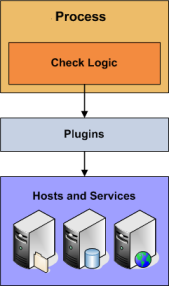
Active checks are initiated by the check logic in the Shinken Enterprise daemon. When Shinken Enterprise needs to check the status of a host or a check, it will execute a plugin and |
...
show the information about what needs to be checked. The plugin will then check the operational state of the host or check and report the results back to the Shinken Enterprise daemon. The scheduler daemon will process the results of the host or check |
...
and take the appropriate action |
...
if necessary (e.g. send notifications, ask for event handlers, etc). | 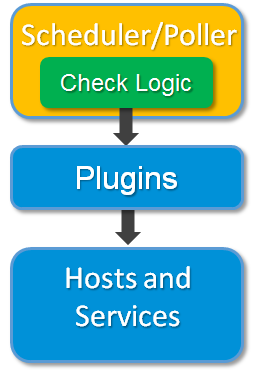 |
When Are Active Checks Executed?
...
Regularly scheduled checks occur at intervals equaling either the "check_interval" or the "retry_interval" in your host or check definitions, depending on what : type of state the host or check is in. If a host or check is in a HARD state, it will be actively checked at intervals equal to the "check_interval" option. If it is in a SOFT state, it will be checked at intervals equal to the retry_interval option.
On-demand checks are performed whenever Shinken Enterprise sees a need to obtain the latest status information about a particular host or check. For example, when Shinken Enterprise is determining the reachability of a host, it will often perform on-demand checks of parent and child hosts to accurately determine the status of a particular network segment.
...
In most cases you'll use Shinken Enterprise to monitor your hosts and checks using regularly scheduled :ref:`active checks <thebasics/activechecks>`active checks. Active checks can be used to "poll" a device or check for status information every so as often as needed. Shinken Enterprise also supports a way to monitor hosts and checks passively instead of actively. They key features of passive checks are as followsthe following:
- Passive checks are initiated and performed by external applications/processes
...
The major difference between active and passive checks is that active checks are initiated and performed by Shinken Enterprise, while passive checks are performed by external applications.
...
Passive checks are useful for monitoring checks that are:
- Asynchronous in by nature, they cannot or would not be monitored effectively by polling their status on a regularly scheduled basis, like backup or batchs
- Located behind a firewall and cannot be checked actively from the monitoring host
...
- "SNMP" traps and security alerts. You never know how many (if any) traps or alerts you'll receive in a given time frame, so it's not feasible possible to just monitor their status every few minutes.
...
- Submitting check results that happen directly within an application without using an intermediate log file(syslog, event log, etc.).
...
- .
How Passive Checks Work
...
Here's how passive checks work in more detail.
|
...
|
- Shinken reads the external command file and places the results of all passive checks into a queue for processing by the appropriate process in the Shinken cloud.
...
|
...
|
...
|
...
The processing of active and passive check results is essentially |
...
the same. This allows for seamless integration of status information from external applications with Shinken Enterprise. | 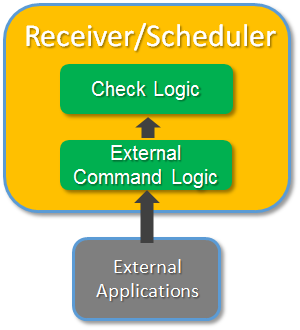 |
Enabling Passive Checks
In order to enable passive checks in Shinken Enterprise, you'll need to do the following:
- Set accept_passive_checkservice_checks directive is set to 1 (in shinken.cfg).
...
- Set the passive_checks_enable" directive in your host and check definitions is set to 1True.
If you want to disable processing of passive checks on a global basis, set theacceptthe accept_passive_check_checks directive to 0.
If you would like want to disable passive checks for just a few hosts or checks, use the "passive_checks_enabled" directive in the host and/or check definitions to do so.
Submitting Passive check
...
Results
External applications can submit passive check check results to Shinken by writing a PROCESS_check_CHECK_RESULT external command to the external command pipe, which is essentially a file handle that you write to as you would a file.
The format of the command is as follows: "[<timestamp>] PROCESS_check_CHECK_RESULT;<host_name>;<svc_description>;<return_code>;<plugin_output>" where...
- timestamp is the time in time_t format (seconds since the UNIX epoch) that the check check was perfomed (or submitted). Please note the single space after the right bracket.
- host_name is the short name of the host associated with the check in the check definition
- svc_description is the description of the check as specified in the check definition
- return_code is the return code of the check (0=OK, 1=WARNING, 2=CRITICAL, 3=UNKNOWN)
- plugin_output is the text output of the check check (i.e. the plugin output)
A check must be defined in Shinken before Shinken will accept passive check results for it! Shinken will ignore all check results for checks that have not been configured before it was last (re)started.
...
You can look at the Enable webservice for passive checks about how to send external checks to the receivers.
External applications can submit passive host check results to Shinken by writing a PROCESS_HOST_CHECK_RESULT external command to the external command file.
The format of the command is as follows: "[<timestamp>]PROCESS_HOST_CHECK_RESULT;<host_name>;<configobjects/host_status>;<plugin_output>" where...
- timestamp is the time in time_t format (seconds since the UNIX epoch) that the host check was perfomed (or submitted). Please note the single space after the right bracket.
- host_name is the short name of the host (as defined in the host definition)
- host_status is the status of the host (0=UP, 1=DOWN, 2=UNREACHABLE)
- plugin_output is the text output of the host check
A host must be defined in Shinken before you can submit passive check results for it! Shinken will ignore all check results for hosts that had not been configured before it was last (re)started.
Once data has been received by the Arbiter process, either directly or through a Receiver daemon, it will forward the check results to the appropriate Scheduler to apply check logic.
Passive Checks and Host States
Unlike with active host checks, Shinken Enterprise does not (by default) attempt to determine whether or host is DOWN or UNREACHABLE with passive checks. Rather, Shinken Enterprise takes the passive check result to be the actual state the host is in and doesn't try to determine the hosts' actual state using the reachability logic . This can cause problems if you are submitting passive checks from a remote host.
...