Abstract
This document describes how you can monitor an MSSQL MySQL database server such as:
- Connection time
- The number of connections
- Cache hit
- etc
There are some steps you’ll need to follow in order to monitor a new database machine:
- Understand what is already available (in the Shinken Entreprise installation)
- Setup the MSSQL MySQL user account
- Test the connection to the database
- Setup your server host definition
| Panel | ||||
|---|---|---|---|---|
| ||||
|
What is already available in the Shinken Installation
To make your life a bit easier, a few configuration tasks have already been done for you:
- Installation of check_mssqlmysql_health plugin : /var/lib/shinken/libexec/check_mssqlmysql_health
- Several host templates are ready to be used
| Tip | ||
|---|---|---|
| ||
| We suppose here that the MSSQL MySQL server you want to monitor is named srv-winlin-1 and is a WindowsLinux. Please change the configuration and commands according with the real name of your server. |
Setup the
MSSQL userMySQL user account
Create the database user
Look at the labs.consol.de/lang/en/nagios/check_mssql_health/ page about how to configure your user connection.
Connect with a root account on your MySQL database. change ‘password’ with your mysql root password:
| Code Block | ||
|---|---|---|
| ||
lin-srv-1:# mysql -u root -ppassword |
And create a shinken user:
| Code Block | ||
|---|---|---|
| ||
GRANT usage ON *.* TO 'shinken'@'%' IDENTIFIED BY 'shinkenpassword'; |
It’s a good thing to change the shinkenpassword to another password. Then you need to update the /etc/shinken/resource.d/mysql.cfg
| Code Block |
|---|
$MYSQLUSER$=shinken
$MYSQLPASSWORD$=shinkenpassword |
Test the connection
To see if the connection to the MSSQL MySQL server is ok using a domain user, just launch :
|
Manage more than 1 database on the same host
Some checks presents in MSSQL templates provided by Shinken Entreprise use the "Duplicate For Each" functionality.
For each database name listed in the DATA "DATABASES", check will be duplicated. An host, having 2 databases, will then have in double each checks with the datatabase name in the check.
| Info | ||
|---|---|---|
| ||
Let's look an example: an host has the following:
|
What is checked with the templates
Public templates
mssqlmysql
This is the very basic MSSQL MySQL template allowing to know if your MSSQL MySQL database server is running and usable.
Every MSSQL MySQL templates (except MssqlMysql-connection-method) use it as a parent template.
| Check | Detail | Scope | Check range | Default Warning | Default Critical | ||||||
|---|---|---|---|---|---|---|---|---|---|---|---|
| connection | Time to connect to the server | database-free | Free space in database | database | 0 to 100%n | 2%1 | 5% | 5 | |||
| restart | Time the server is running | free-list-stalls | Requests per second that had to wait for a free page | server | 0 to n | 4 | 10 | page-life-expectancy | Seconds a page is kept in memory before being flushed | : | 5: |
| slow_queries | slow_queriesserver | 0 to n | 300: | 180: | 0.1 | 1 | |||||
| tmp_disk_tables | Percent of temp tables created on disk | total-server-memory | The amount of memory that SQL Server has allocated to it | server | 0 to n | 100000025 | 500000050 |
mysql-full
Contains all MSSQL MySQL host templates listed in the Shinken Adminstrators templates.
| Warning | ||
|---|---|---|
| ||
Using the mssqlmysql-full template will require a lot of resources on your poller daemon. We advise to use only the needed templates. |
Shinken Administrator templates (can't be seen by other users)
mssqlmysql-connection-method
This template describes the method to connect to MSSQL MySQL server. Every MSSQL MySQL templates use it as a parent template.
mssql
mysql-
availabilitycluster
This template gives informations about the database availabilityMySQL cluster.
| Check | Detail | Scope | Check range | Default Warning | Default Critical |
|---|---|---|---|---|---|
| connection | Time to connect to the server | server | 0 to n sec | 1 | 2 |
mysql-innoDB
This template gives informations about the backup age of your databasesinnoDB buffers and logwaits.
| Check | Detail | Scope | Check range | Default Warning | Default Critical | ||
|---|---|---|---|---|---|---|---|
| bufferpool_hitrate | InnoDB buffer pool hitrate | database-backup-age | Elapsed time (in hours) since a database was last backed up | database | 0 to n hours | 4899: | 72 |
mssql-batch-requests
This template gives informations about the batch requests.
| 95: | |||||
| bufferpool_wait_free | InnoDB buffer pool waits for clean page available | ||||
| Check | Detail | Scope | Check range | Default Warning | Default Critical |
|---|---|---|---|---|---|
| batch-requests | Batch requests per second | server | 0 to n | 1001 | 200 |
mssql-checkpoint-pages
This template gives informations about the checkpoint pages.
| Check | Detail | Scope | Check range | Default Warning | Default Critical |
|---|---|---|---|---|---|
| checkpoint-pages | Dirty pages flushed to disk per second. (usually by a checkpoint) | server | 0 to n | 100 | 500 |
mssql-compilations
This template gives informations about compilations.
| Check | Detail | Scope | Check range | Default Warning | Default Critical |
|---|---|---|---|---|---|
| sql-initcompilations | Initial compilations per second | server | 0 to n | 100 | 200 |
| sql-recompilations | Re-Compilations per second | server | 0 to n | 1 | 10 |
| 10 | ||||
| log_waits | InnoDB log waits because of a too small log buffer | 0 to n | 1 | 10 |
mysql-MyISAM
mssql-full-scansThis template gives informations about the full scansMyISAM key cache hitrate.
| Check | DetailScope | Check range | Default Warning | Default Critical | ||
|---|---|---|---|---|---|---|
| fullkeycache-scans | Full table scans per second | hitrate | MyISAM key cache hitrateserver | 0 to n | 10099: | 50095: |
mysql-
latchperformance
This template gives informations about the latchesglobal server performance.
| Check | Detail | Scope | Check range | Default Warning | Default Critical | |||
|---|---|---|---|---|---|---|---|---|
| index_usage | Usage of indexes | latches-wait-time | Average time for a latch to wait before the request is met | server | 0 to n | 190: | 5 | 80: |
| long_running_procs | long running processes | latches-waits | Number of latch requests that could not be granted immediately | server | 0 to n | 1050 |
mssql-lazy-writes
This template gives informations about the lazy writes.
| Check | Detail | Scope | Check range | Default Warning | Default Critical |
|---|---|---|---|---|---|
| lazy-writes | Lazy writes per second | server | 0 to n | 20 | 40 |
| 20 | |
| table_lock_contention | Table lock contention |
mssql-locks
This template gives informations about locks.
| Check | Detail | Scope | Check range | Default Warning | Default Critical | ||||
|---|---|---|---|---|---|---|---|---|---|
| locks-deadlock | The number of deadlocks per second | server | 0 to n | 1 | 5 | locks-timeouts | The number of locks per second that timed out | server | 2 |
| tablecache_hitrate | Table cache hitrate | 0 to n | 199: | 95: | |||||
| threadcache_hitrate | Hit rate of the thread-cache | 5 | locks-waits | The number of locks per second that had to wait | server | 0 to n | 10010 | 50020 |
mysql-
serverquery-
performancecache
This template gives informations about MSSQL server performancequery cache.
| Check | Detail | Scope | Check range | Default Warning | Default Critical | ||||||||||
|---|---|---|---|---|---|---|---|---|---|---|---|---|---|---|---|
| qcache_hitrate | Query cache hitrate | cpu-busy | Cpu busy in percent | server | 0 to n | 80 | 90 | io-busy | IO busy in percent | server | 0 to n90: | 80: | 90 | mem-pool-data-buffer-hit-ratio | Data Buffer Cache Hit Ratio |
| qcache_lowmem_prunes | Query cache entries pruned because of low memoryserver | 0 to n | 90:180: | 10 |
mysql-
transactionsusage
This template gives informations about databases transactionsMySQL server usage.
| Check | Detail | Scope | Check range | Default Warning | Default Critical | ||
|---|---|---|---|---|---|---|---|
| open_files | Percent of opened files | transactions | Transactions per second (per database) | database | 0 to n | 1000080 | 50000 |
mssql-usage
This template gives informations about the database usage.
| 95 | |||||
| threads_connected | |||||
| Check | Detail | Scope | Check range | Default Warning | Default Critical |
|---|---|---|---|---|---|
| connected-users | Number of currently connected usersserveropen connections | 0 to n | 5010 | 8020 |
How to
Configuration of
MssqlMysql-connection-method host template
Click on Hosts then on Hosts Templates in the Elements menu | |
In the Name field, type mssqlmysql-connection. Then clic on mssqlmysql-connection-method | 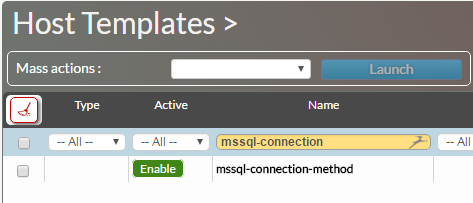 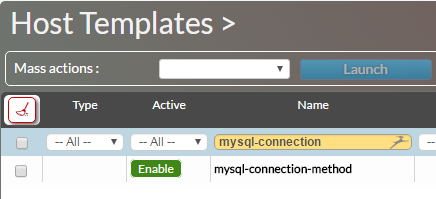 |
| Clic on Data tab | |
You can setup the following DATA :
|
|
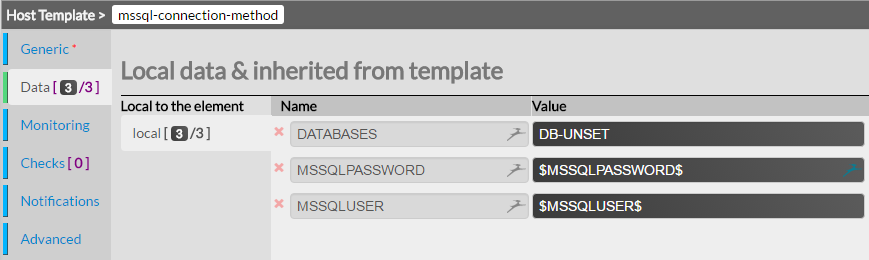
|
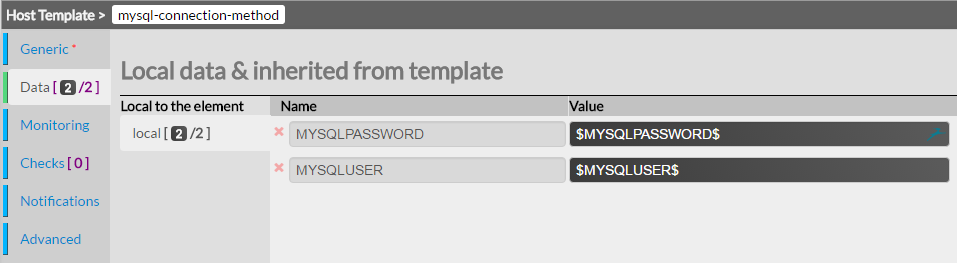
| Tip | ||
|---|---|---|
You can also set the user and password directly in /etc/shinken/resource.d/myslq.cfg
|
Attach a MySQL
The parameters specifics to each server, such as database name for example, has to be done in the host's data itself.| Tip | ||
|---|---|---|
| ||
It's a best practice to use the same database monitoring user on every MSSQL server monitored. Doing so, you can configure the database user/password only once in the host template oracle-connection-method. |
template to you host
| Clic on Hosts in the Elements menu | |
Add the chosen Oracle MySQL host template to the Host Templates to inherit field. For example the Oracle MySQL host template. |   |
Click on the Data tab | 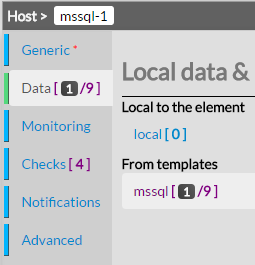 |
Look for the field DATABASES in the From templates data | |
Type the name of the database to be monitoring |  |
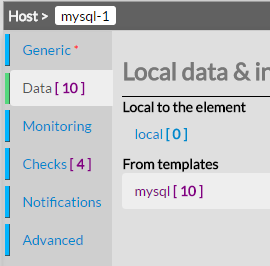 | |
| Check if the Following data are ok. | 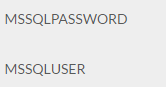 |
| title | Tip |
|---|
You can monitor multiple database on the same host in typing the name of the database name separated by a comma.
Exemple : DB1,DB2,DB3