Description
...
...
- From the chosen host, it displays in 3 dimensional the dependency tree up to 10 jumps (dependency links between elements defined in the configuration).
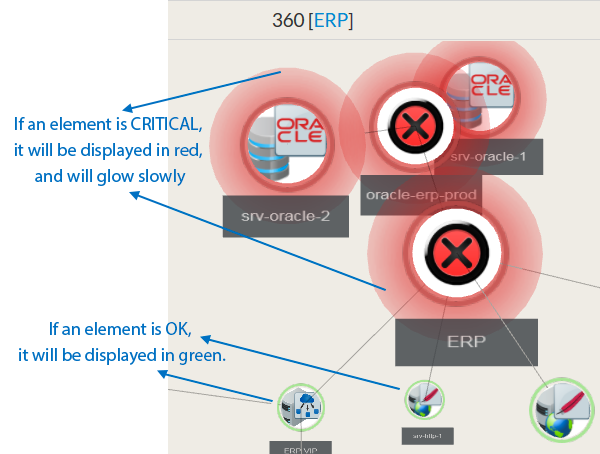
- If an element is Critical, it will be displayed in red, and will glow slowly.
- If an element is OK, it will be displayed in green.
...
...
...
...
...
...
|
...
Usage
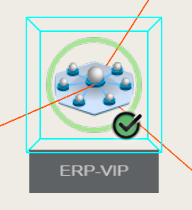
- The double click will zoom and center the view on the selected element. You will have a blue box surrounding this element.
|
From the chosen host, it displays the 3D dependency tree up to 10 jumps (dependency links between elements defined in the Configuration UI)
| Panel |
|---|
|
Usage
Center an element in the view:
- Double click on an element, a blue wired box will surround, indicating it's now selected.
- The view will pan and update zoom level accordingly.
Orbit around the selected element:
- While keeping left mouse button pressed, move the mouse to orbit around the selected element.
- to change the orbiting center, center the view on an other element.
Pan View:
While keeping the right mouse button pressed, move mouse to pan view.
| Panel |
|---|
|
Configuration
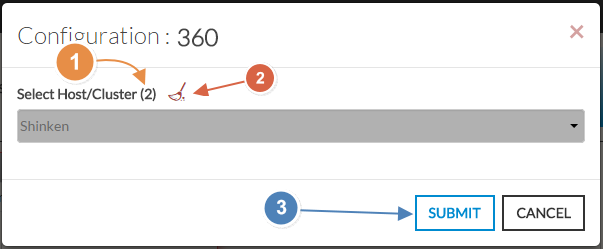
- Select a host or cluster name in the first list.
- The total number of hosts and clusters will be displayed near "Select Host/Cluster" (1).
- If no host selected yet, the list of available hosts will automatically opened.
- You can search (filter) for a host name, typing into the input on top of the list.
- Youcan clean the current selection by clicking on the swipe icon (2).
- When configured, press the SUBMIT button (3).
...