Overview
Commands are configuration elements used to describe plugins usage.
It tells Shinken Enterprise where to find plugins, how to use it, what arguments are necessary, and how to substitute arguments by Data.
For example, check_ping is a plugin used to ping a host, and get informations about network connectivity with host :
check_ping -H <host_address> -w <wrta>,<wpl>% -c <crta>,<cpl>% |
Plugin help tells that to use the command, we need to pass, as argument the following :
- -H : host address
- -w : wrta,wpl (Warning Round Trip Average, Warning Packet Loss)
- -c : crta, cpl (Critical Round Trip Average, Critical Packet Loss)
The corresponding commands should be :
check_ping -H $HOSTADDRESS$ -w $ARG1$ -c $ARG2$ |
In this way, Shinken Enterprise will able to replace arguments by the corresponding value, depending of HOSTADDRESS and arguments given to command.
Accessing Commands configuration
Commands Configuration can be accessed by the Main Menu "Commands".
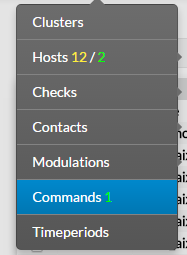
When accessing the Commands Configuration Page, a Command Table is displayed, listing all Commands objects.
On the top of the table, A tool bar let Administrators the ability to :
- Enable, Disable, Delete or Duplicate selected Commands
- Filter list by Name

This table contains the following informations :
- A check box to select one or more commands
- Differences
- Name
- Poller Tag
- Reactionner Tag
- Pack
- Status
This page also provides, on the left, an action Menu, used to :
- Add a new Command
- Show Commands detected by Automatic Modules
- Accept differences on selected elements
Create a new Command
To create a new Command, use the button "Add new [Command]" located in the Action Menu
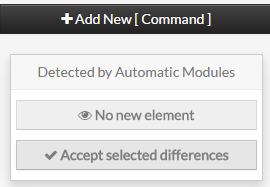
Command creation form will be displayed.
This form is composed of tabs, corresponding to categories of properties :
Generic
Advanced
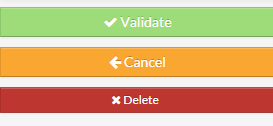
The left menu give to Administrators the ability to :
- Validate the new Command
- Cancel the action
- Delete the Command
Generic
Generic properties contains the minimum properties requiered to create a Command :
- Name
the name of the Command
this field is requiered
- Command
- the plugin configuration
- the value is a text field, defining the plugin syntax (see example in Overview)

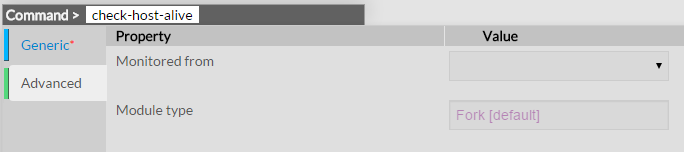
Advanced
Advanced properties are used to define Advanced features like :
- Monitored from
- the poller tag that the command should run on
- Module Type
- the poller module the command should run in the poller daemon
Modify a command
To modify properties of a command, first go on the Commands page, from the Main menu,
then click on the command name you want to modify.

The form displayed is the same as the form used to create a new Command.
All fields are filled with Command properties.
Once changes have been made, configuration of the Command must be saved by clicking the Validate button available on the left menu. Cancel button revert all changes to previous configuration.
Delete a command
From the Form page
First go to the Commands page, from the Main menu, then click on the command name you want to delete.
Once in the page displaying the form, click on the Delete button available on the left menu.
A confirmation popup will be displayed.
From the Main page
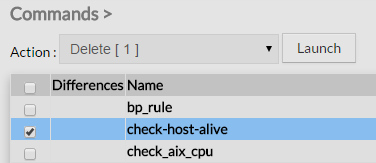
First go to the Commands page, from the Main menu, then click on the check box placed on the first column of the table.
Use the Action menu on the top to select Delete, and click to the Launch Button.
A confirmation popup will be displayed.
Using the Main page gives Administrators ability to Delete many Commands at once.
Duplicate a command
To duplicate a command, first go on the Main page listing all commands,
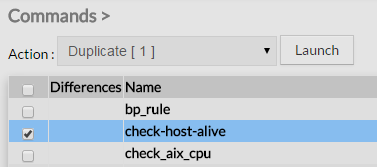
then select a comand by clicking on the check box placed on the first column.

Once selected, the command can be duplicated by selecting Duplicate in the select Action of the tool bar.
Duplication is executed by clicking the Launch button.
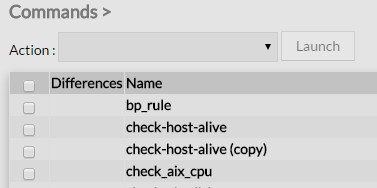
Using the Main page gives Administrators ability to Duplicate many Commands at once.
All properties are kept when duplicating operation, as well as data.
Duplicated commands are totally detached and independent of the cloned command. No relation is made in the configuration. |