Introduction
Le module broker-module-livedata permet d'envoyer des requêtes API afin de recevoir des informations sur un hôte, un cluster, un check attaché à un hôte ou un check attaché à un cluster. Il est possible de modifier certains paramètres dans la configuration (comme le port d'écoute et le token).
Configuration
Voici le fichier CFG de configuration présent dans : /etc/shinken/modules/broker-module-livedata.cfg
#===============================================================================
# broker module livedata
#===============================================================================
# Daemons that can load this module:
# - broker
# This module is an api getting information from the broker
#===============================================================================

define module {

    #======== Module identity =========
    # Module name. Must be unique
    module_name               broker-module-livedata

    # Module type (to load module code). Do not edit.
    module_type               broker_module_livedata

    #======== Listening address =========
    # host: IP address to listen to.
    #       note: 0.0.0.0 = all interfaces.
    host                      0.0.0.0
    # port to listen
    port                      8000

    # HTTPs part, enable if you want to set the visualisation interface listen in HTTPs mode
    # disabled by default. Set your own certificates. Set your own token, it is usefull to get access to the API
    use_ssl                   0
    ssl_cert                  /etc/shinken/certs/server.cert
    ssl_key                   /etc/shinken/certs/server.key
    token                     ak5zv6t5s25r6g4
}
|
Mise en marche du module
Pour mettre en marche votre module il vous faut l'ajouter à la listes des modules actifs sur le broker souhaité.
Pour se faire, rendez vous dans le fichier de configuration de votre broker à l'emplacement /etc/shinken/brokers/nom_de_votre_broker.cfg à la ligne suivante:
[...]
    modules                   Simple-log, WebUI, Graphite-Perfdata, sla, Livestatus, broker-module-livedata
[...] |
Redémarrez ensuite votre Arbiter pour que la configuration du Broker soit active.
service shinken-arbiter [ -d ] restart |
Fonctionnement
L'accès à cette API est restreinte aux détenteurs d'un token généré dans la configuration (modifiable par l'utilisateur) du module.
Appeler l'API
URL = http://{ip_broker}:{port_module}/api/V1/host/408cd29ad37611e8810e0800277b7e16?token={token}
ou https://IP_DU_BROKER:PORT_DU_MODULE/api/V1/TYPE/UUID?token=TOKEN_DU_MODULE
Exemple pour un hôte avec le module sur le port 8000 du broker en localhost et "adt" comme token :
http://localhost:8000/api/V1/host/408cd29ad37611e8810e0800277b7e16?token=adt
DIRE QUE CA RENVOIE DU JSON
Routes de l'API (titre a changer)
GET /api/V1/host/{uuid}
Description incroyable de mon appel
Paramètres
uuid ca fait des trucs (dans un tableau c'est plus joli)
Réponse
Codes de retour
Explication codes de retour
200 OK
4XX Token de merde
404 Host not found
Tete de la réponse (titre a changer)
- host_uuid : text
- host_name : text
- host_display_name : text
- status : text
- OK
- WARNING
- CRITICAL
- UNKNOWN
- MISSING-DATA
- SHINKEN-INACTIVE
- status_since : epoch (en secondes)
- context : text
- NOTHING
- ACKNOWLEDGED
- PARTIAL-ACKNOWLEDGED
- INHERITED-ACKNOWLEDGED
- DOWNTIME
- PARTIAL-DOWNTIME
- INHERITED-DOWNTIME
- FLAPPING
- PARTIAL-FLAPPING
- DISABLED
business_impact : 0, 1, 2, 3, 4, 5
output : text
long_output : text
Exemple
{
 "status": "OK",
 "host_display_name": "localhost",
 "long_output": "",
 "host_name": "localhost",
 "context": "NOTHING",
 "status_since": 1540457802,
 "business_impact": 2,
 "output": "PING OK - Packet loss = 0%, RTA = 0.02 ms",
 "host_uuid": "408cd29ad37611e8810e0800277b7e16"
}
|
Check attaché à un hôte
GET /api/V1/check-on-host/UUID
- check_uuid : text
- check_name : text
- check_display_name : text
- status : text
- OK
- WARNING
- CRITICAL
- UNKNOWN
- MISSING-DATA
- SHINKEN-INACTIVE
- status_since : epoch (en secondes)
- context : text
- NOTHING
- ACKNOWLEDGED
- PARTIAL-ACKNOWLEDGED
- INHERITED-ACKNOWLEDGED
- DOWNTIME
- PARTIAL-DOWNTIME
- INHERITED-DOWNTIME
- FLAPPING
- PARTIAL-FLAPPING
- DISABLED
- output : text
- business_impact : 0, 1, 2, 3, 4, 5
- long_output : text
- host_uuid : text
- host_name : text
- host_display_name : text
Exemple
{
 "status": "OK",
 "host_display_name": "localhost",
 "check_name": "Broker Daemon Livedata - broker-master",
 "host_uuid": "408cd29ad37611e8810e0800277b7e16",
 "long_output": "",
 "host_name": "localhost",
 "context": "NOTHING",
 "output": "<span style=\"color:#2A9A3D;font-weight:bold;\">[OK]</span> The example works fine.<br/>",
 "business_impact": 2,
 "status_since": 1540457781.797493,
 "check_uuid": "022a505c849f840e110f2aba5e27597f",
 "check_display_name": "Broker Daemon Livedata - broker-master"
}
|
Cluster
GET /api/V1/cluster/UUID
- cluster_uuid : text
- cluster_name : text
- cluster_display_name : text
- status : text
- OK
- WARNING
- CRITICAL
- UNKNOWN
- MISSING-DATA
- SHINKEN-INACTIVE
- status_since : epoch (en secondes)
- context : text
- NOTHING
- ACKNOWLEDGED
- PARTIAL-ACKNOWLEDGED
- INHERITED-ACKNOWLEDGED
- DOWNTIME
- PARTIAL-DOWNTIME
- INHERITED-DOWNTIME
- FLAPPING
- PARTIAL-FLAPPING
- DISABLED
- business_impact : 0, 1, 2, 3, 4, 5
- output : text
- long_output : text
Exemple
{
 "status": "OK",
 "cluster_display_name": "localhost",
 "long_output": "",
 "cluster_name": "localhost",
 "context": "NOTHING",
 "status_since": 1540457802,
 "business_impact": 2,
 "output": "PING OK - Packet loss = 0%, RTA = 0.02 ms",
 "cluster_uuid": "408gfhfr7611e8810e0800277b7e16"
}
|
Check attaché à un cluster
GET /api/V1/check-on-cluster/UUID
- check_uuid : text
- check_name : text
- check_display_name : text
- status : text
- OK
- WARNING
- CRITICAL
- UNKNOWN
- MISSING-DATA
- SHINKEN-INACTIVE
- status_since : epoch (en secondes)
- context : text
- NOTHING
- ACKNOWLEDGED
- PARTIAL-ACKNOWLEDGED
- INHERITED-ACKNOWLEDGED
- DOWNTIME
- PARTIAL-DOWNTIME
- INHERITED-DOWNTIME
- FLAPPING
- PARTIAL-FLAPPING
- DISABLED
- output : text
- business_impact : 0, 1, 2, 3, 4, 5
- long_output : text
- cluster_uuid : text
- cluster_name : text
- cluster_display_name : text
Exemple
{
 "status": "OK",
 "cluster_display_name": "localhost",
 "check_name": "Broker Daemon Livedata - broker-master",
 "cluster_uuid": "408gfhfr7611e8810e0800277b7e16",
 "long_output": "",
 "cluster_name": "localhost",
 "context": "NOTHING",
 "output": "<span style=\"color:#2A9A3D;font-weight:bold;\">[OK]</span> The example works fine.<br/>",
 "business_impact": 2,
 "status_since": 1540457781.797493,
 "check_uuid": "044a505c849f840e110f2aba5e27597f",
 "check_display_name": "Example cluster check"
}
|
Obtenir un UUID
Hôtes et Clusters
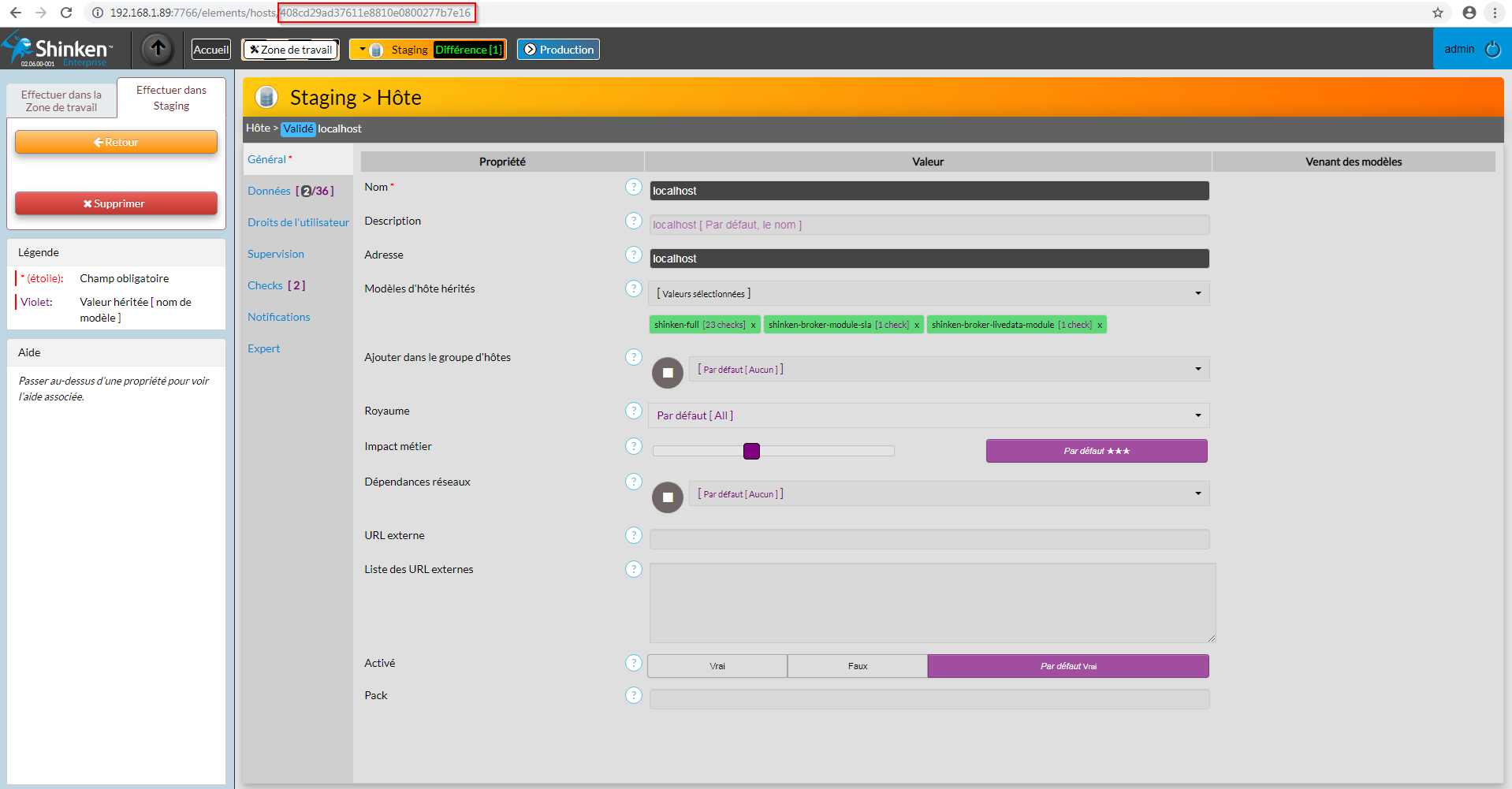
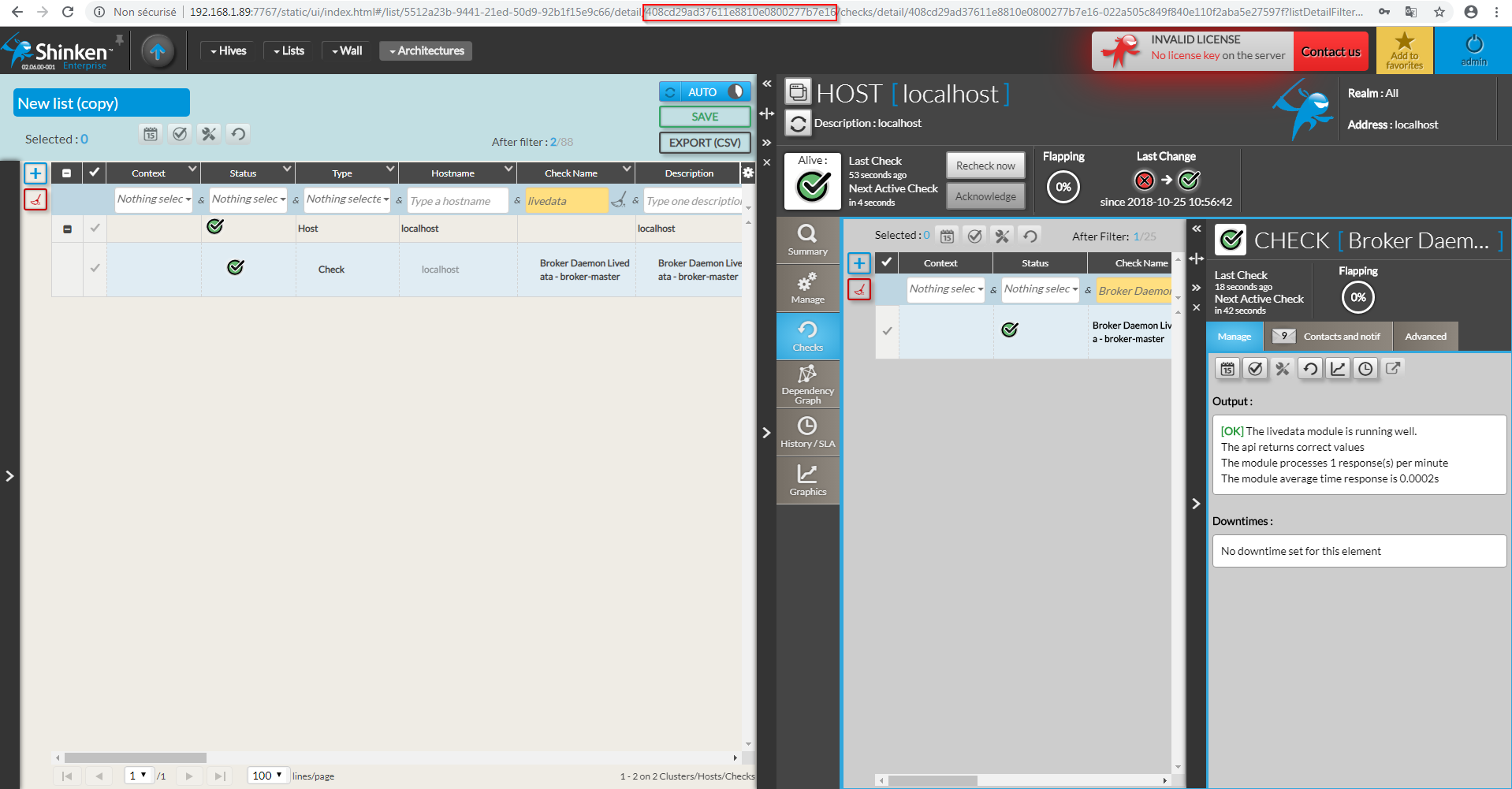
Pour récupérer l'uuid d'un hôte ou d'un cluster il suffit de se rendre dans sa page de configuration sur l'UI de Configuration, ou de le sélectionner dans l'UI de Visualisation. Il se trouve alors dans l'url tel que :
|
|
Checks attachés
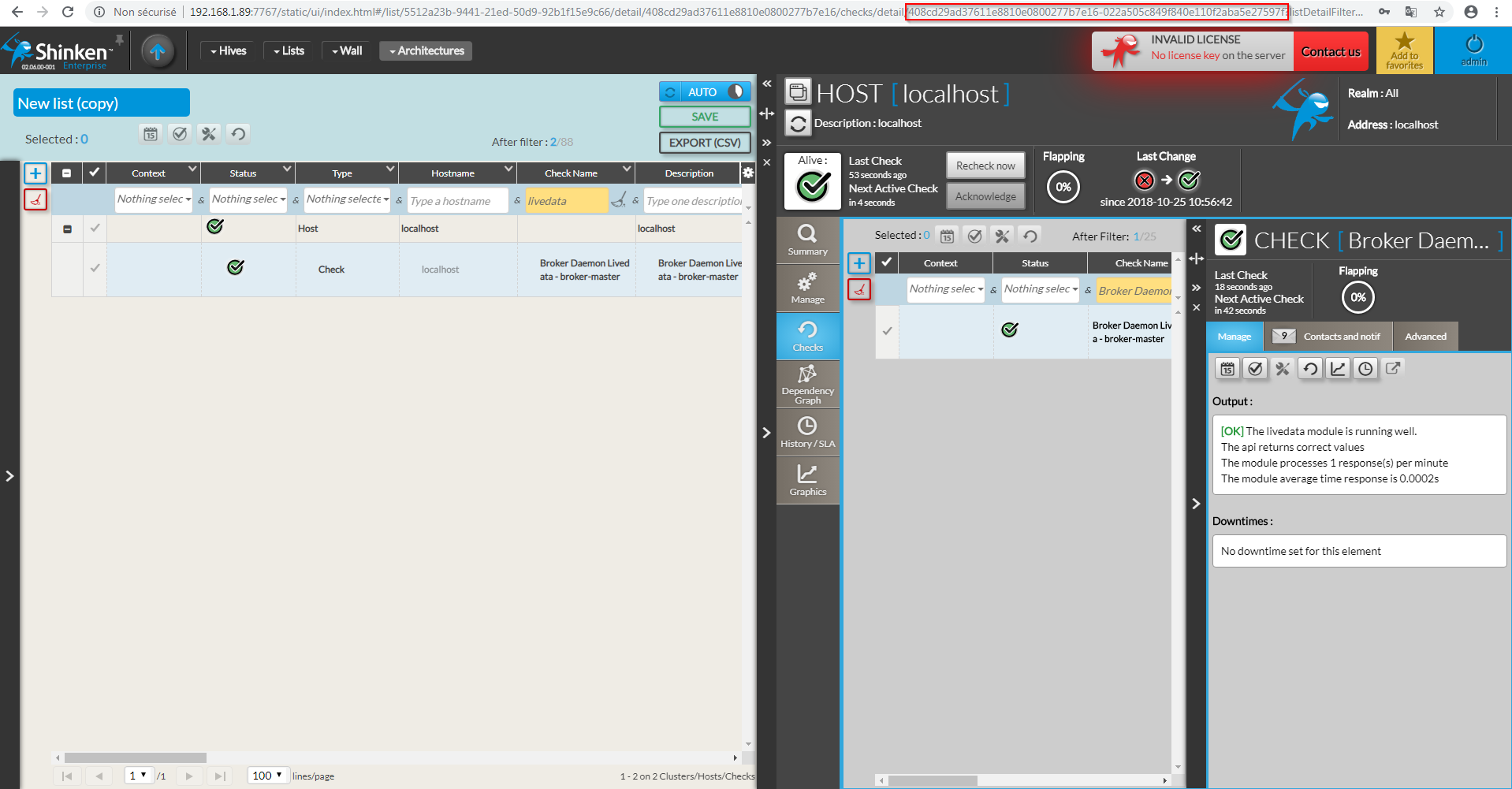
Pour récupérer l'uuid d'un check attaché à un hôte ou à un cluster, il suffit de se rendre dans sa page de configuration sur l'UI de Configuration en y rajoutant l'uuid de l'hôte ou du cluster sur lequel il est attaché, suivit d'un tiret. Ou plus simplement dans l'UI de Visualisation.
|
AJOUTER UN TRUC SUR LES MACROS (commandes notifs)