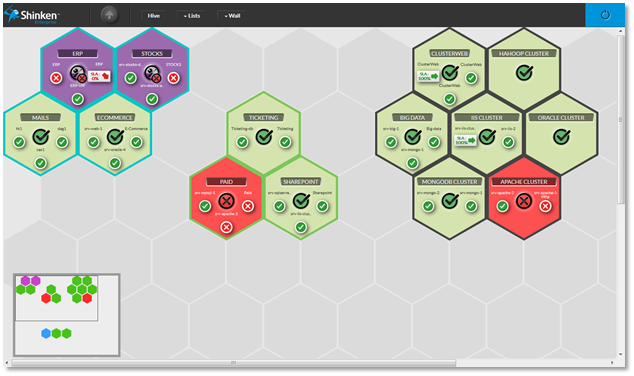
Each user has its own hive of dashboards' summaries.
The hive can be customized as needed, the user can organize the monitoring overview in the most efficient way.
Let’s study this hive to learn the possibilities of the visual monitoring interface.
The hive will help you to organize visually your overview of elements that need to be monitored.
The hive displays tiles and empty alveolus in which you can create new tiles or move existing tiles.
The hive has no size limit. Each time you add a new tile near the edge, the hive will extend itself by adding 2 columns or rows of empty alveolus.
Each tile is a summary of a Dashboard.
A dashboard is a visual container of information which will help you to investigate issue sources (see Dashboard chapter for more details).
It contains:
| 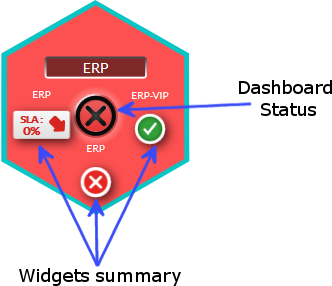 |
When initialy created, a tile will have
Editing the display of the tile is done into the dashboard it is linked to.
Create a new tileClick on an empty alveolus. An empty tile with the default name will then be created. | 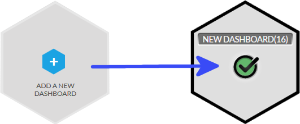 |
Move a tile / switch 2 tilesDrag a tile to the empty alveolus to move it. Drag a tile on another one to switch both tiles. | |
Delete a tileDrag a tile in the garbage can that appears at the bottom right corner of the screen. | 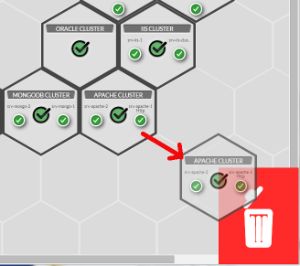 |
Open the Dashboard linked to a tileSimply click on the tile. |
You will notice that some tiles have the same border color. You can set this color to tiles group. It is up to you to choose your organization. As an example, you can choose a color to differentiate data centers. This color can be set when editing the Dashboard linked to the tile (see Dashboard chapter).
The image show you the example of the green group. | 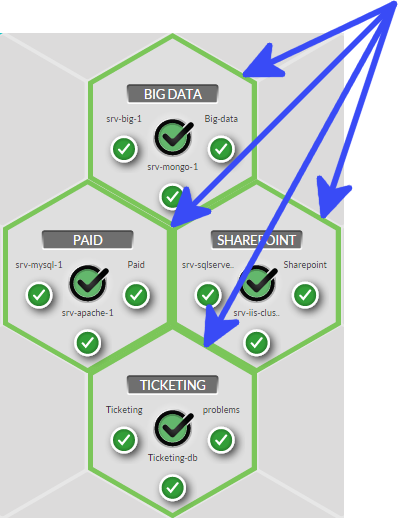 |
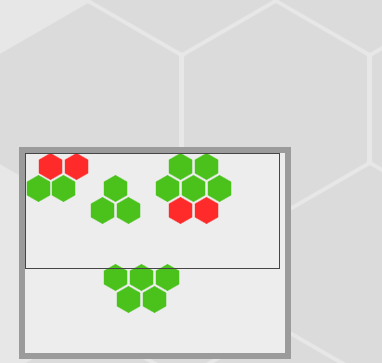
The mini map is located at the bottom left corner of the hive It will help you to navigate faster if your hive is bigger than your computer screen.
You just have to
|  |