Overview
Escalation is an optionnal feature used to send different level of notifications, according to specific rules.
Escalation can apply on Hosts and Checks.
See Notification escalations for more informations.
This feature is very useful when you want to send notifications to different level of user, fitting the technical hierarchy, when a problem is not resolved immediatly :
| Time (minutes) | Notification |
|---|
| 0 | Operational support |
| 10 | Support Manager |
| 20 | Technical Manager |
Escalations are available from the Contacts Menu 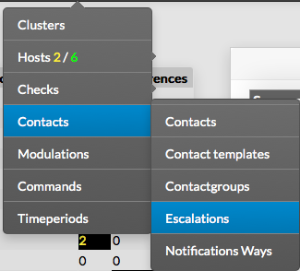
| |
The main page of escalations, gives a list of all existing escalations with following details : - a CheckBox used to select on or more escalations
- differences since last commit
- name of the escalation
- Escalation Start, level of notification the escalation is effective
- Escalation End, level of notification the escalation stops
- Contacts
- Contact Groups
- Status

| |
On the top of the table, A tool bar let Administrators the ability to : - Enable, Disable, Delete or Duplicate selected escalations
- Filter List by Name
| |
Add an escalation
To create a new escalation, use the button "Add new [Escalation]" located in the Action Menu 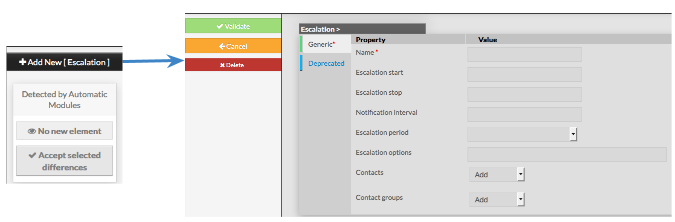
| |
The form displayed will is composed of two tabs : - Generic, containing all necessary options
- Deprecated, used for compatibilty only, should not be filled
| |
The left menu give to Administrators the ability to : - Validate the new escalation
- Cancel the action
- Delete the escalation
| |
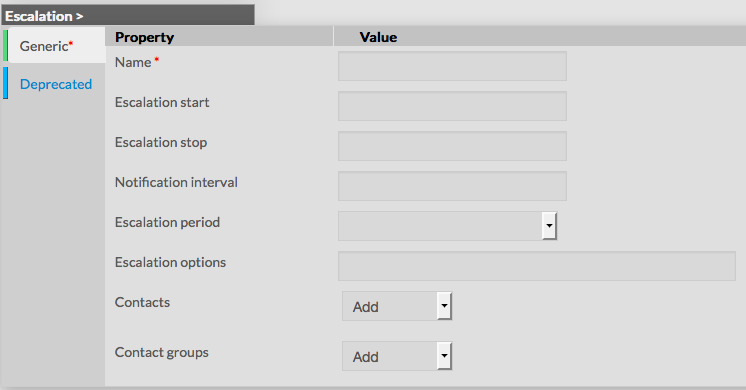
Generic category form contains following options : - Name
- the name of the escalation
- this field is required
- Escalation start
- the start level, making the escalation effective
- value must be an integer
- Escalation stop
- the stop level, represents the last notification for which escalation is effective
- value must be an integer, higher than Escalation start
- Notification interval
- this value tells the reccuring period to which escalation will be sent out
- value must be an integer
- if no value is filled, meaning 0, only one notification will be sent
- Escalation period
- this value is used to set on which period notifications should be sent
- the value must be selected from the dropdown, listing all existing timeperiods
- Escalation options
- list of flags, used to dertmine what state should generate an escalation
- field is a list of comma seperated values, valid values are :
- r : send an escalation on RECOVERY state
- d : send an escalation on a DOWN state
- u : send a escalation on UNREACHABLE or UNKNOWN state
- w : send an escalation on a WARNING state
- c : send an escalation on a CRITICAL state
- note : if value is empty, escalation will be sent for any state of host or check
- Contacts
- list of contacts that should be notified when escalation is effective
- values is a list of contact, available from the dropdown list
- Contact groups
- list of contactgroups that should be notified when escalation is effective
- values is a list of contact groups, available from the dropdown list
|  |
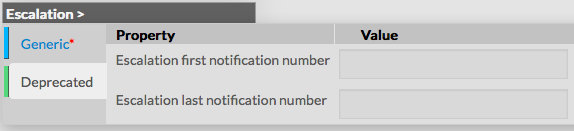
| Deprecated | |
This tab is for compatibility only, it should not be used as those properties will disapear in future versions - Escalation first notification number : replacd by Escalation start
- Escalation last notification number : replaced by Escalation stop
|  |
Modify an escalation
To modify properties of an escalation, first go on the Escalations page, from the Main menu,
and then click on the escalation name you want to modify.
The form displayed is the same as the form used to create a new Escalation.
All fields are filled with Escalation properties. Once changes have been made, configuration of the Escalation must be saved by clicking the Validate button
available on the left menu. Cancel button revert all changes to precedent configuration. |  |
Delete an escalation
| To delete an escalation, you can use the form of the escalation, or delete it directly from the list page. | |
From the Form page First go to the Escalations page, from the Main menu, then click on the escalation name you want to delete. Once in the page displaying the form, click on the Delete button available on the left menu. A confirmation popup will be displayed. | 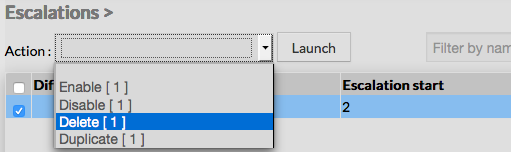 |
From the Main page First go to the Escalations page, from the Main menu, then click on the check box placed on the first column of the table. Use the Action menu on the top to select Delete, and click to the Launch Button. A confirmation popup will be displayed. | 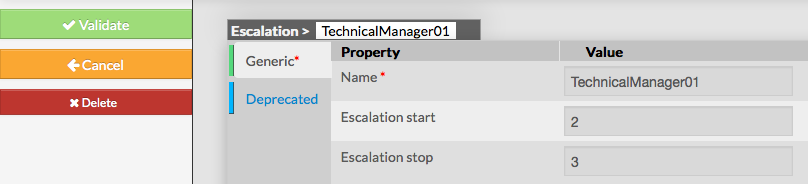
|
Using the Main page gives Administrators ability to Delete many Escalations at once.
Duplicate an escalation
Duplication operation is very useful when similar Escalations must be added.
| To duplicate an escalation, first go on the Main page listing all escalations, then select a escalation by clicking on the check box placed on the first column. | |
| Once selected, the esclation can be duplicated by selecting Duplicate in the select Action of the tool bar. Duplication is executed by clicking the Launch button. | 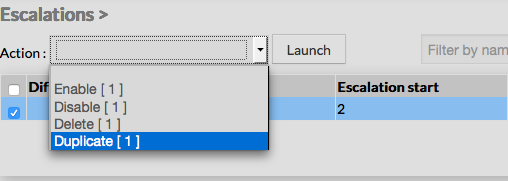 |
| The name of escalation duplicated is suffixed by "(copy)". |  |
Using the Main page gives Administrators ability to Dublicate many Escalations at once.
Duplicated Escalations are totaly detached and independant of the cloned Escalation. No relation is made in the configuration.