This architecture is fully flexible and scalable. To improve Shinken Enterprise capacity, increasing the number of daemons of the same role is the best way.
Shinken Enterprise is able to cut the user configuration into parts and dispatch it to the schedulers.
The load balancing is done automatically: the administrator does not need to remember which host is linked to another one to create packs.
The dispatch is a host-based one: that means that all checks of a host will be in the same scheduler as this host. That means that the administrator does not need to know all relations among elements like parents, host dependencies or check dependencies: Shinken Enterprise is able to look at these relations and put these related elements into the same shard.
This action is done in two parts:
The cutting action is done by looking at two elements: hosts and checks. Checks are linked with their host so they will be in the same shard.
Other relations are taken into consideration :
Shinken Enterprise looks at all these relations and creates a graph with it. A graph is a relation shard.
This can be illustrated by the following picture :
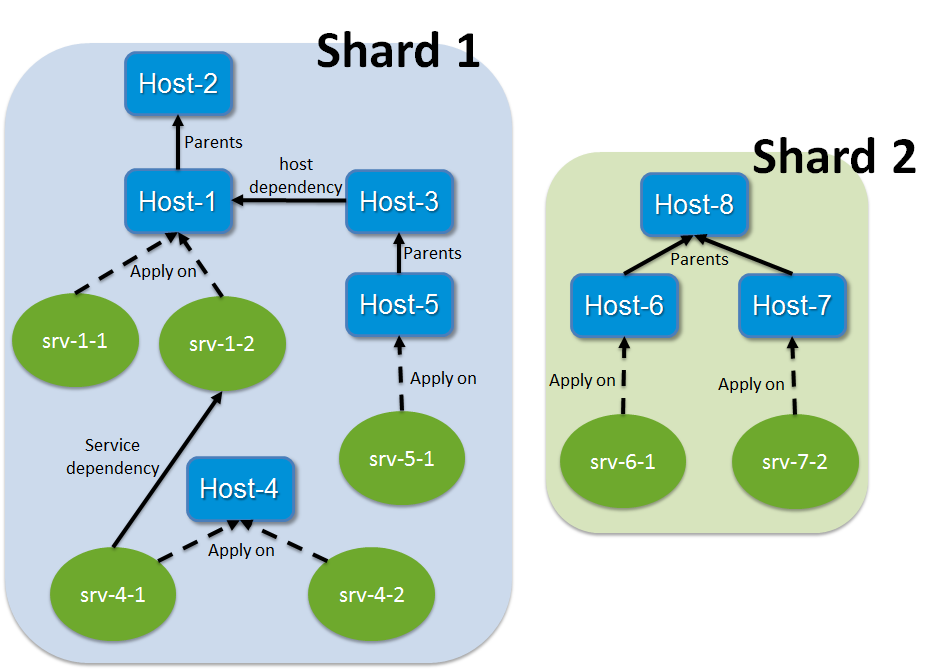
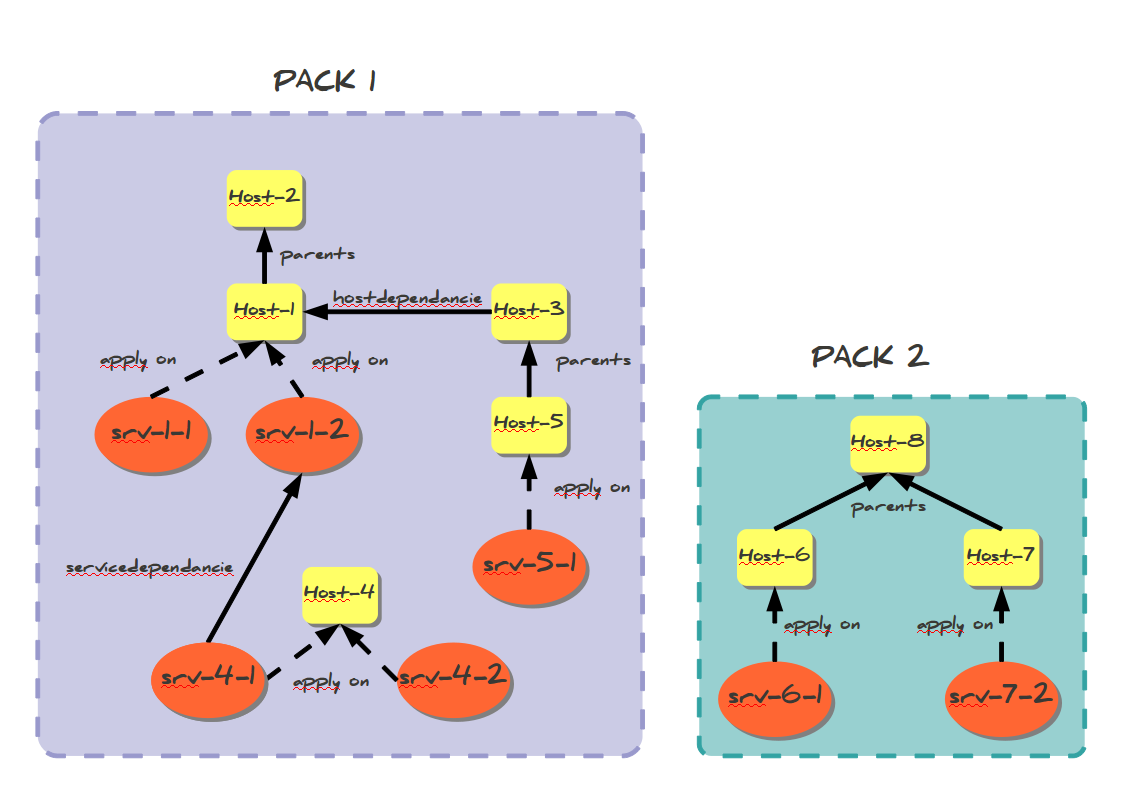
In this example, we will have two shards:
When all shards are created, the Arbiter aggregates them into N configurations if the administrator has defined N active schedulers (no spares).
Shards are aggregated into configurations (it's like "Big packs").
The dispatch looks at the weight property of schedulers: the higher weight a scheduler has, the more packs it will have.
This can be shown in the following picture :
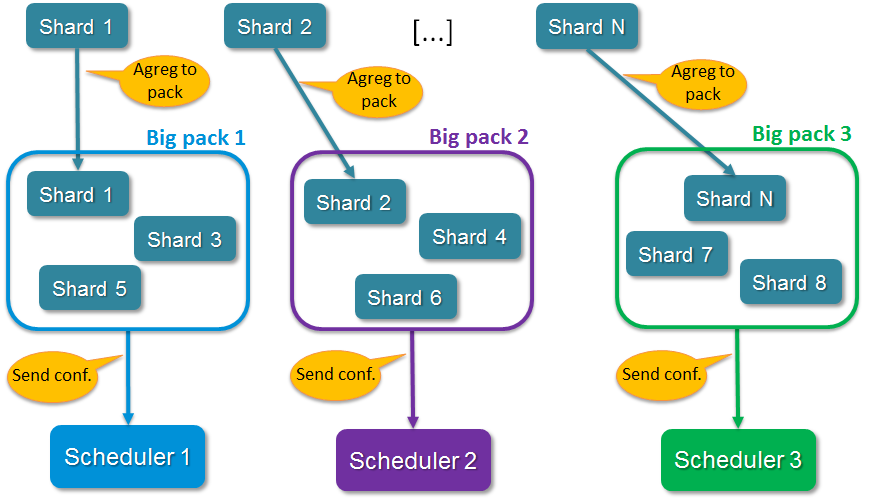
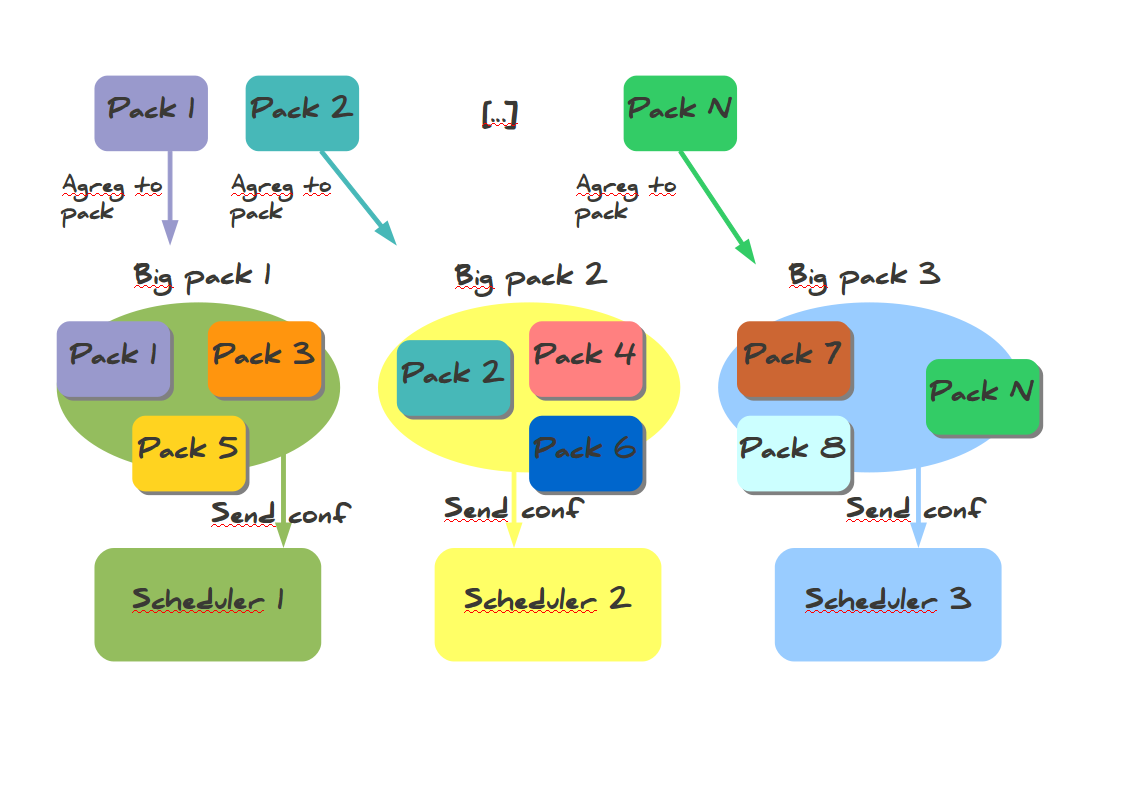
When all configurations are created, the Arbiter sends them to the N active Schedulers.
A Scheduler can start processing checks once it has received and loaded it's configuration without having to wait for all schedulers to be ready.
For larger configurations, having more than one Scheduler, even on a single server is highly recommended, as they will load their configurations (new or updated) faster.
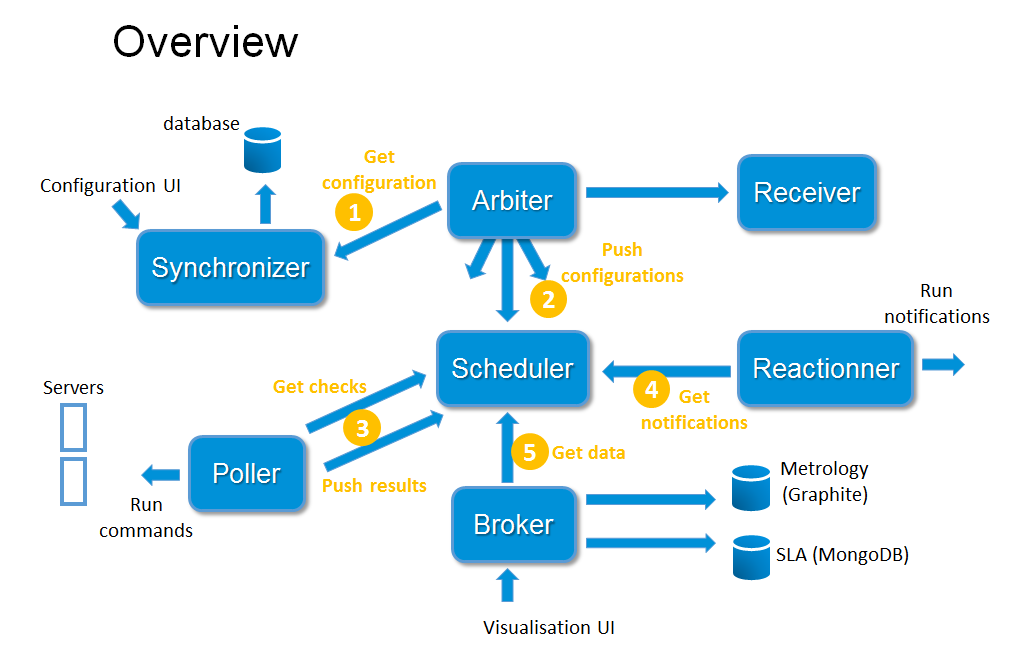
The Arbiter also creates configurations for satellites (pollers, reactionners and brokers) with links to Schedulers so they know where to get jobs to do.
After sending the configurations, the Arbiter begins to watch for orders (called external command) from the users and is responsible for monitoring the availability of the satellites.
The Shinken Enterprise architecture is a high availability one. Before looking at how this works, let's take a look at how the load balancing works.
Nobody is perfect. A server can crash, an application too. That is why administrators have spares: they can take configurations of failing elements and reassign them.
For the moment the only daemon that does not have a spare is the Arbiter, but this will be added in the future. The Arbiter regularly checks if everyone is available. If a scheduler or another satellite is dead, the Arbiter sends its conf to a spare node, defined by the administrator.
The availability parameters can be modified from the default settings when using larger configurations as the Schedulers or Brokers can become busy and delay their availability responses.
The timers are aggressive by default for smaller installations ( See Daemons configuration parameters for more information on the three timers involved ).
The administrator needs to send orders to the schedulers (like a new status for passive checks).
In Shinken Enterprise, the administrator just sends the order to the Arbiter, that's all. External commands can be divided into two types :
For each command, Shinken Enterprise knows if it is global or not:
When the order is received by schedulers they just need to apply them.