Rôle
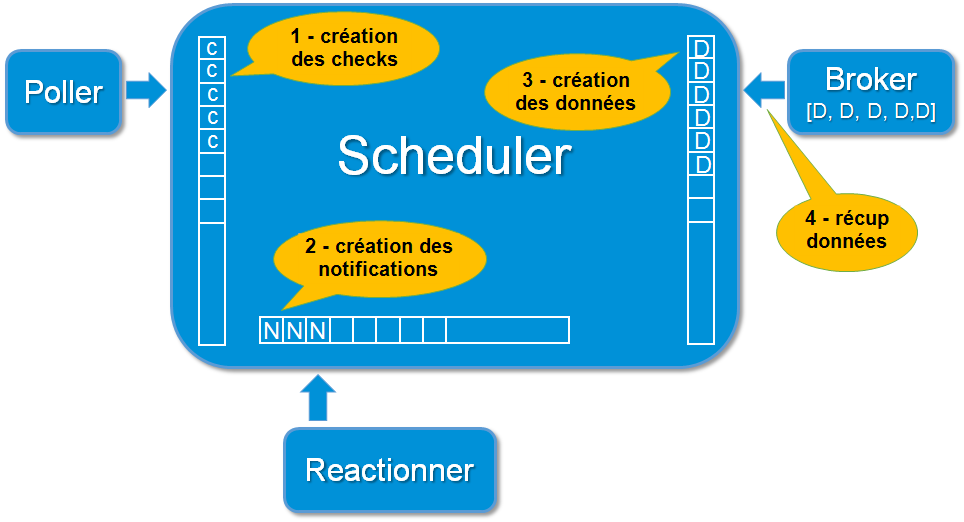
Le démon Broker exporte et gère les données du Scheduler ( les objets Broks ).
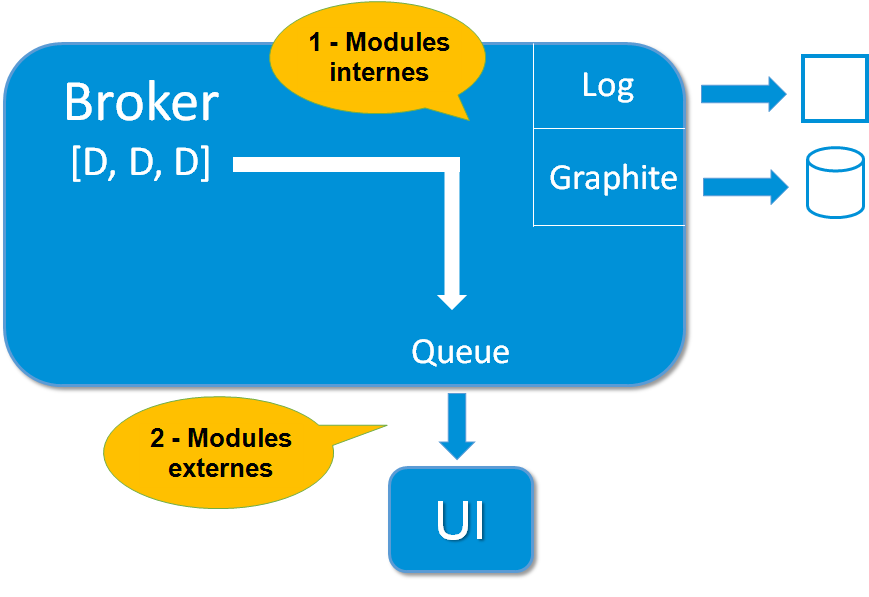
- Sa gestion ne peut se faire qu'à travers des modules.
- Plusieurs modules de gestion peuvent être activés en même temps.
Exemples de modules du Broker :
- Module pour exporter les données de métrologie: Graphite-Perfdata
- Module pour l'API Livedata
- Module pour l'affichage de l'interface de visualisation : WebUI
Données : les Broks
Le Broker reçoit toutes les données des Schedulers. Ce sont les objets Broks.
Les Broks sont des conteneurs de données échangées entre les Schedulers et les Brokers. Il y a plusieurs types de Broks :
|
Le rôle du démon Broker est de donner ces données ( Broks ) à tous ses modules.
|
Données de métrologie
Les données de métrologie sont sauvegardées sur le serveur du Broker dans l'application graphite.
Cette application écoute le port 2003, et cette connexion se fait sans authentification.
Cette application doit donc écouter exclusivement sur l'interface réseau locale ( loopback ) du serveur du Broker.
Logique interne du Broker
|
Résumé des connexions du Broker
| Source | Destination | Port | Protocole | Note |
|---|---|---|---|---|
| Broker | Scheduler | 7768 | HTTP/HTTPS |
Description des variables
|
Définition - exemple
Dans le répertoire /etc/shinken/brokers/, voici un exemple de définition qui permet la définition du Broker ( à placer dans un fichier CFG ) :
 Il est conseillé d'éditer les fichiers .cfg avec l'encodage utf-8
#===============================================================================
# BROKER
#===============================================================================
# Description: The broker is responsible for:
# - Exporting centralized logs of all Shinken daemon processes
# - Exporting status data
# - Exporting performance data
# - Exposing Shinken APIs:
#   - Status data
#   - Performance data
#   - Command interface
#===============================================================================

define broker {

# Shinken Enterprise. Lines added by import core. Do not remove it, it's used by Shinken Enterprise to update your objects if you re-import them.
    _SE_UUID            core-broker-060340145ade11e5b703080027f08538
    _SE_UUID_HASH       8e00136f9e61061e07ca0f4a63509b68
# End of Shinken Enterprise part

    #======== Daemon name and address =========
    # Daemon name. Must be unique
    broker_name               broker-master

    # IP/fqdn of this daemon (note: you MUST change it by the real ip/fqdn of this server)
    address                   localhost

    # Port (HTTP/HTTPS) exposed by this daemon
    port                      7772

    # 0 = use HTTP, 1 = use HTTPS
    use_ssl	                  0


    #======== Master or spare selection =========
    # 1 = is a spare, 0 = is not a spare
    spare                     0

    # spare_daemon: name of the daemon that will take this daemon job if it dies
    # IMPORTANT:
    #   * a spare_daemon can only be the spare of 1 (and only one) master daemon
    #   * a spare_daemon cannot have a spare_daemon
    #   * the spare must have modules with the same module_type as the master
    #     - depending of the value of the broker__manage_spare__spare_must_have_the_same_list_of_module_type parameter
    # Example: spare_daemon              broker-spare
    spare_daemon

    # 1 = (default) the spare defined with spare_daemon must have the same module_type as this master
    # 0 = the spare module_type are not checked
    # broker__manage_spare__spare_must_have_the_same_list_of_module_type     1


    #======== Daemon connection timeout and down state limit =========
    # timeout: how many seconds to consider a node don't answer
    timeout                   3

    # data_timeout: how many second to consider a configuration transfer to be failed
    # because the network bandwidth is too small.
    data_timeout              120

    # max_check_attempts: how many fail check to consider this daemon as DEAD
    max_check_attempts        3

    # Check this daemon every X seconds
    check_interval            60


    #======== Modules to enable for this daemon =========
    # Available:
    # - WebUI                   : Visualisation interface
    # - Graphite-Perfdata       : Save all metrics into a graphite database
    # - sla                     : Save sla into a database
    # - Livestatus              : TCP API to query element state, used by nagios external tools like NagVis or Thruk
    # - broker-module-livedata  : REST API to query all monitored element data (host, cluster or check)
    # - event-manager-writer    : Save events for events manager (do not forget to activate the module in your webui to see data)
    # - Simple-log              : Save all logs into a common file, Use this module only if you need to have all the check results in one file.
    modules                  WebUI, Graphite-Perfdata, sla, event-manager-writer


    #======== Realm and architecture settings =========
    # Realm to set this daemon into
    realm                    All

    # 1 = take data from the daemon realm and its sub realms
    # 0 = take data only from the daemon realm
    manage_sub_realms        1

    # In NATted environments, you declare each satellite ip[:port] as seen by
    # *this* daemon (if port not set, the port declared by satellite itself
    # is used)
    #satellitemap    scheduler-1=1.2.3.4:7768, scheduler-2=1.2.3.5:7771

    # Exchange between brokers <- schedulers can be limited by packet size (in kB)
    # Note: as compression is automatic, this is a higher limit, and in real case the
    #       packets will be lower than this value
    # broks_packet_size 1024


    #======== Memory protection =========
    # Are the daemon module process and worker process are waiting for enough
    # memory to be available before being launch. Default: 1 (enabled)
    broker__manage_brok__enable_sub_processes_memory_usage_protection   1

    # The sub process memory usage protection can have a system reserved memory
    # that won't be used by theses sub process when launched
    # By default: 0 (no reserved memory)
    # Example: 10  (means 10% of the total memory is reserved for the system)
    broker__manage_brok__sub_process_memory_usage_system_reserved_memory    0

    # If a sub process cannot be started because of the protection, how many seconds
    # it will be retry and wait that the system memory is freed until it fail to start
    # By default: 5 (seconds)
    broker__manage_brok__sub_processes_memory_usage_protection_max_retry_time   5


    #======== Brok pusher worker =========
    # The broker spawn broks pusher sub process to push to external modules (like WebUI)
    # the broker will look at this worker execution time, and will kill if it timeout
    # The broker will compute the average execution time of previous workers to
    # decide about how many time this worker will take based on:
    # number of broks to send / past average send speed (broks/s)
    # If this time is reach, it means that the pusher process is killed

    # For small amount of broks to send, it should lead to ridiculously small allowed execution time
    # and the fac to spawn the sub process can be higher than this value, so we are using a minimal
    # execution timeout
    # Default: 5 (second)
    broker__manage_brok__sub_process_broks_pusher_min_execution_timeout           5

    # In order to manage the fact that the server can slow down during this send, you can setup a
    # ratio that will be used to increase the allowed timeout by multiply it
    # Default: 5
    broker__manage_brok__sub_process_broks_pusher_security_ratio                  5

    # At the broker start without stats, this valid will be used for the timeout
    # Default: 240 (seconds)
    broker__manage_brok__sub_process_broks_pusher_max_execution_timeout           240

    # If a sub process reach a timeout, it will be killed and relaunched. After max retry,
    # the attached module will be restarted
    # Default: 3
    broker__manage_brok__sub_process_broks_pusher_max_retry                       3

    # broker__manage_brok__sub_process_broks_pusher_queue_batch_size:
    #   * defines the maximum number of broks the "queue brok pusher"
    #     process will handle per send to external module ( like WebUI ) .
    #   * Remaining broks will be handled in next send.
    #   * IMPORTANT: increase this value can lead to error on the socket
    # Default: 100000 (broks/batch)
    # broker__manage_brok__sub_process_broks_pusher_queue_batch_size      100000

    # Broks whose serialization time exceeds this threshold will generate a warning
    # Default: 100 (milliseconds)
    # broker__manage_brok__oversized_data_warning_threshold__serialization_time   100

    # Broks whose serialization time exceeds this threshold will generate an error
    # Default: 500 (milliseconds)
    # broker__manage_brok__oversized_data_error_threshold__serialization_time     500


    #======== VMWare / ESXi ==========
    # 1 (default) = if vmware get the ESXi CPU stats value, 0 = do not get value
    vmware__statistics_compute_enable     1


    #======== Enable or not this daemon =========
    # 1 = is enabled, 0 = is disabled
    enabled                  1

}
|
|