What is the correlation?
The main role of this feature is to allow users to have the same correlation views in the console than they got in the notifications.
From now, users won't be notified if there was a dependency problem or example (a host in DOWN make the check notifications in the state "not to be send" for example). But in the console, we still got some green and red indicators: the scheduler waited for actual checks to put the elements in a UNKNOWN or UNREACHABLE state when it already knows that there was a dependency problem.
Now it's smart enough to put such states to elements that we know the check will fail. An example?
Imagine such a parent relations between hosts:
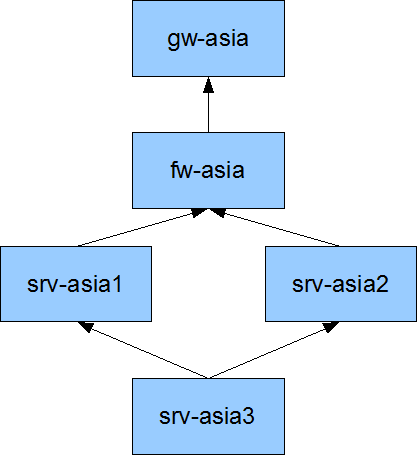 | If gw is DOWN, all checks for others elements will put UNREACHABLE state. But if the fw and servers are checked 5 minutes later, during this period, the console will still have green indicators for them. And are they really green? No. We know that future checks will put them in errors. That why the problems/impacts feature do: when the gateway is set in HARD/DOWN, it applies an UNREACHABLE (and UNKNOWN for checks) states for others elements below. So the administrators in front of his desk sees directly that there is a problem, and what are the elements impacted. |
It's important to see that such state change do not interfere with the HARD/SOFT logic: it's just a state change for visualization interface, but it's not taken into consideration as a check attempt.
In this case, gateway is already in DOWN/HARD. We can see that all servers do not have an output: they are not already checked, but we already set the UNREACHABLE state. When they will be checked, there will be an output and they will keep this state.
How to enable it?
It's quite easy, all you need is to enable the parameter:
enable_problem_impacts_states_change=1 |
Dynamic priority
There is a good thing about problems and impacts when you do not identify a parent device priority: your problem will dynamically inherit the maximum priority of the failed child!
Let's take an example: you have a switch with different children, one is a development environment with a low priority (0 or 1) and one with a huge priority (4 or 5). The network administrator has set SMS notification at night but only for HUGE prioritys (Minimum Filter Priority is 4 in the contact definition for example).
It's important to say that the switch does not have its own priority defined! A switch is there just linked to the server applications, the only priority it gets is the child hosts and checks that are connected to it!
There are 2 scenario for 2 different nights:
- the first one, the switch got a problem, and only the development environment is impacted. The switch will inherit the maximum impact of its impacts (or it own value if it's higher, it's 2 by default for all elements). Here the development impact is 0, the switch one is 2, so its impact will stay at 2. It's slower than the contact value, so the notification will not be send, the admin will be able to sleep.
- the second night, the switch got a problem, but this time it impacts the production environment! This time, the computed impact is set at 5 (the one of the max impact, here the production application), so it's higher than the Minimum Priority Filter of the contact, so the notification is send. The admin is awaken, and can solve this problem before too many users are impacted :)