What are Automatic detection modules
Automatic Detection Modules will analyse external sources and wil extract all possibles informations to create automaticaly hosts and affect them specific behaviours.
The Automatic detection modules are managed by the Synchronizer daemon. It uses sources to detect new hosts and host modifications. It presents the configuration web interface to the administrators. Here are the optional sources the daemon can use to get information:
- Active directory
- VSphere (VMWare)
- Nagios or Shinken framework configuration files
- Network scans
How Automatic detection modules are working
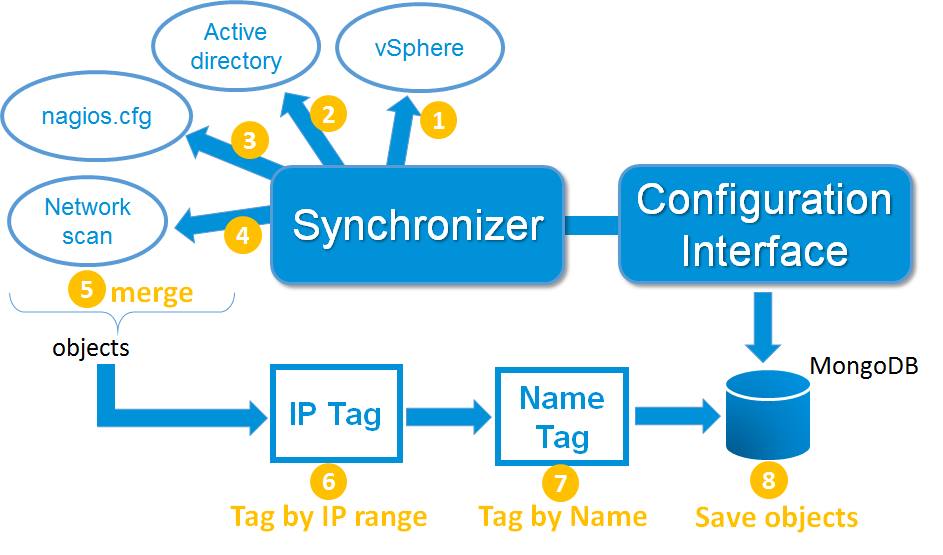
- Step 1 to 4: The Sources defined in the automatic detection modules are scheduled by the Synchronizer daemon every few minutes. They will query and load various data from external application and generate partial hosts objects (step 1 to 4).
- Step 5: the synchronizer daemon merge all the partial hosts objects by detecting which part is refering to the same hosts. All detected hosts properties are merged, and if there is a conflict between partial objects, the property from the source with the lower order is used.
- Step 6: the merged objects are going through the IP tag tagger, that will try to request the host IP address, and will compare it to IP ranges configured on the IP Tag tagger. If the host IP is in the rule IP range, then a new host template is added to the host object.
- Step 7: the merged objects are going through the Name tagger, that will compare the host name to regexp rules configured on the Name tagger. If the host name match the regexp rule, then a new host template is added to the host object
- Step 8: the detected objects are saved in the mongodb database.