...
| Source | Destination | Port | Protocol | Note |
|---|---|---|---|---|
| Reactionner | Schedulers | 7768 | HTTPS |
The broker
Role
The broker daemon exports and manages data from schedulers. The management can be done exclusively with modules. Multiple broker modules can be enabled simultaneously. Example of broker modules:
...
- Modules for the Livestatus API
...
Data
The
...
broker daemon get all monitoring data from the schedulers. it will also keep in memory host and service data. It also save checks results into a mongodb database. If possible, this database should be local to the broker server.
Metrology data
The metrology data are saved on the broker server by the graphite application. This application is listening to the 2003 port, and this connexion is without authentification. So this application should be local and limited to the localhost address of the broker server.
Broker connexion summary
| Source | Destination | Port | Protocol | Note |
|---|---|---|---|---|
| Broker | Scheduler | 7768 | HTTPS | |
| Broker | Poller | 7771 | HTTPS | |
| Broker | Reactionner | 7769 | HTTPS | |
| Broker | Receiver | 7773 | HTTPS | |
| Broker | Broker (local) | 2003 | TCP | localhost only interface |
The receiver
Role
The receiver daemon receives passive check data and serves as a distributed passive command buffer that will be read by the arbiter daemon. There can be many receivers for load-balancing and hot standby spare roles. The receiver can also The receiver daemon receives passive check data and serves as a distributed passive command buffer that will be read by the arbiter daemon. There can be many receivers for load-balancing and hot standby spare roles. The receiver can also use modules to accept data from different protocols.
- Module for passive data collection: WS arbiter module
...
Other daemon communications
The arbiter will get data from the receiver each seconds.
Data
The receiver keep in memory a buffer of external commands. Theses external commands have host and checks names.
Receiver connexion summary
None.
Architecture summary
This architecture is fully flexible and scalable: the daemons that require more performance are the poller and the schedulers. The administrator can add as many as he wants.
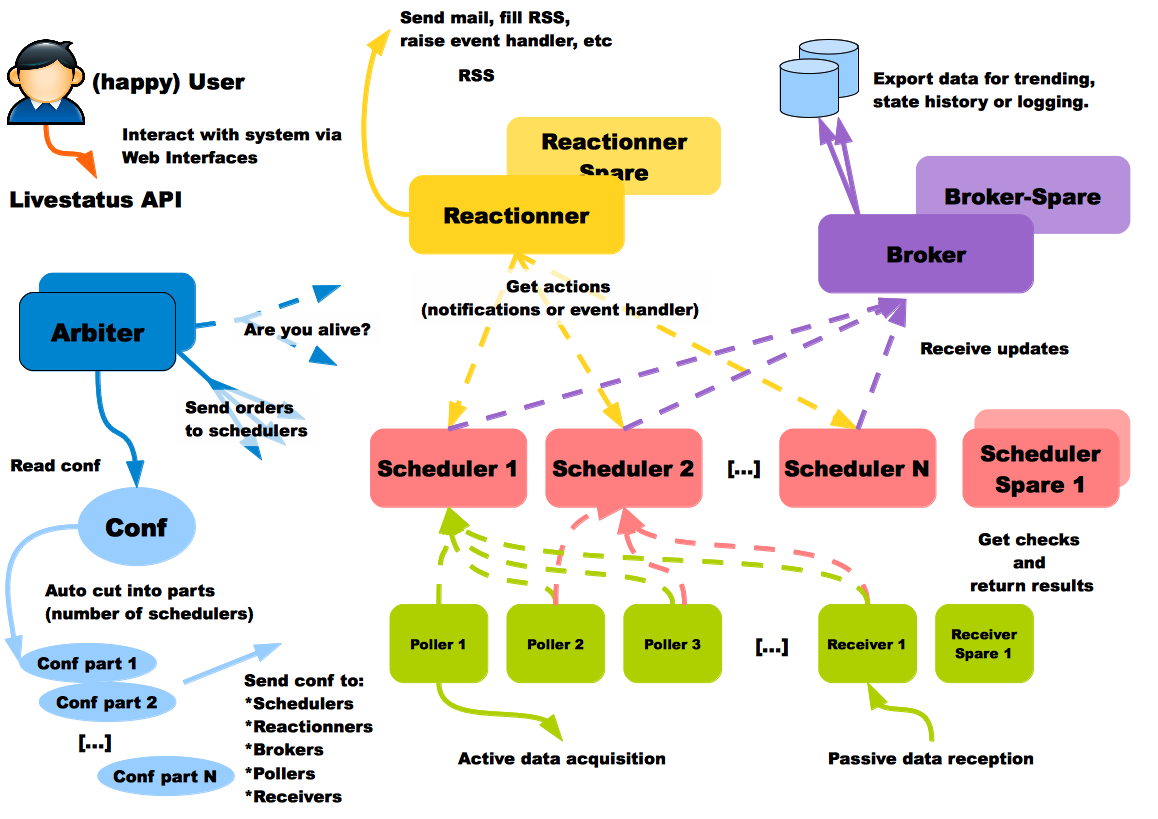
Automatic load balancing
...