...
The dispatch is a host-based one: that means that all services checks of a host will be in the same scheduler as this host. That means that the administrator does not need to know all relations among elements like parents, host dependencies or service check dependencies: Shinken Enterprise is able to look at these relations and put these related elements into the same shard.
...
The cutting action is done by looking at two elements: hosts and serviceschecks. Services Checks are linked with their host so they will be in the same shard.
Other relations are taken into consideration :
- Network relationship for hosts (like a distant server and its router).
- Host logicial dependencies.
Shinken Enterprise looks at all these relations and creates a graph with it. A graph is a relation shard.
This can be illustrated by the following picture :
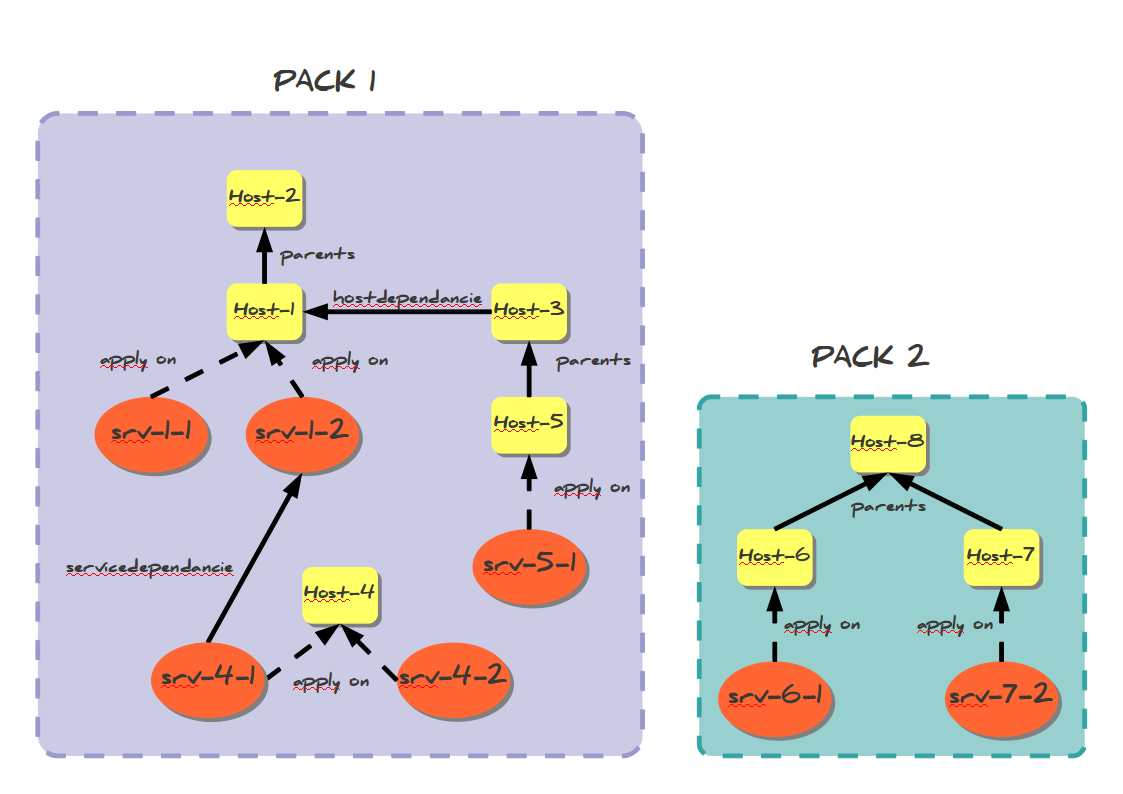
In this example, we will have two shards:
- shard 1: Host-1 to host-5 and all their serviceschecks
- shard 2: Host-6 to Host-8 and all their serviceschecks
The shard aggregation into the schedulers
...
- commands that are specific to one element (host/servicecheck)
For each command, Shinken knows if it is global or not. If global, it just sends orders to all schedulers. For specific ones instead it searches which scheduler manages the element referred by the command (host/servicecheck) and sends the order to this scheduler. When the order is received by schedulers they just need to apply them.
...