|
To create a new Contact, use the button "Add new [Contact]" located in the Action Menu. Contact creation form will be displayed. 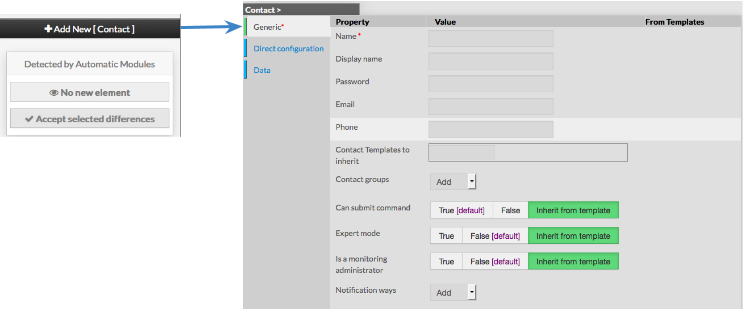 |
This form is composed of tabs, corresponding to categories of properties : Generic Direct Configuration Data
|
The left menu give to Administrators the ability to : - Validate the new contact
- Cancel the action
- Delete the contact
|
| | |
|
| Generic properties contains the minimum properties required to create a Contact : |
- Name
the name of the Contact this field is required
- Display name
- the name that will be displayed in the visualization interface and in notifications
- Password
- the Password that the user will use to connect to the visualization interface
- the password is hidden when editing the contact
- Email
- email address of the contact, used to notify him
- Phone
- phone number of the contact, used to notify by pager for example
- Contact Templates to inherit
- list of templates the contact should inherit from
- templates name are suggested when starting to fill the field
- Contact groups
- List of contact groups the contact should be in
- more than one contact groups can be selected
- Can submit command
- option used to determine if user will be able to schedule
a new check through the visualization interface
| 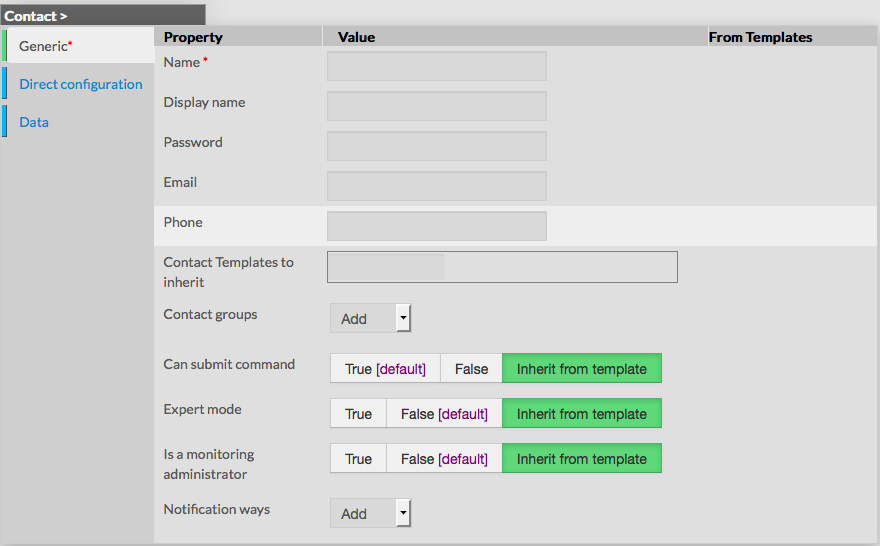
- Expert mode
- option used to determine if the user will be able
to see the expert mode in the visualization interface
- Is a monitoring Administrator
- option used to give the user Administrators rights,
ie UI Configuration Access
- Notification ways
- list of notification ways used to notify the contact
(by email, by pager etc.)
|
| | |
|
| This category is used to define properties linked to the notifications, like Periods, Type of notification and Options. |
- Host notification period
- define the period within contact will be notified about host alerts
- the value must be selected from the available time period list
- Check notification period
- define the period within contact will be notified about service alerts
- the value must be selected from the available time period list
- Enable host notifications
- determines if notifications should be sent about host alerts
- default value is taken from Contact template
- Enable check notifications
- determines if notifications should be sent about service alerts
- default value is taken from Contact template
- Host notification commands
- this option let the ability to select the command that will be used
to notify the contact about host alerts - multiple notification command can be selected
- default value is taken from contact template
- Checks notification commands
- this option gives the ability to select the command that will be used
to notify the contact about service alerts - default value is taken from contact template
- Host notification options
- this option is used to define host states for which notifications should be sent
- value is a comma separated list of flags
- valid options are :
- d : down
- u : unreachable
- r : recovery
- f : flapping
- s : scheduled downtime
- n : none
- default value is taken from contact template
- if no flag is present, contact will be notified according to host properties
| 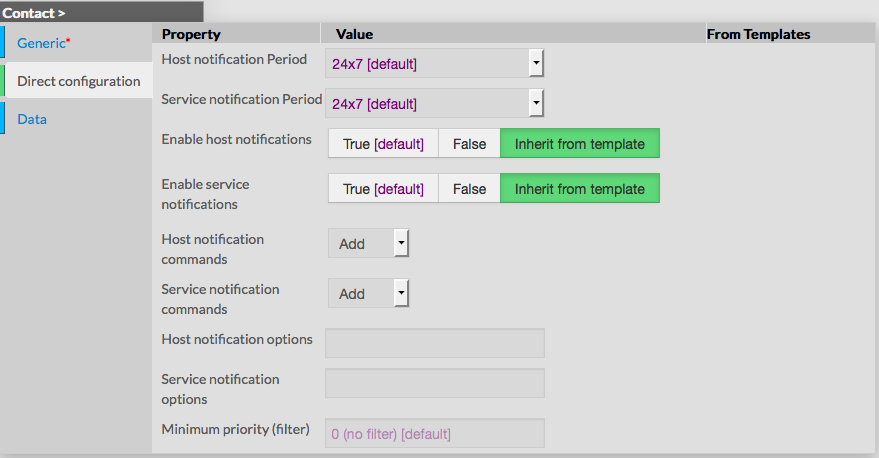
- Check notification options
- this option is used to define check states
for which notifications should be sent - value is a comma seperated list of flags
- valid options are :
- w : warning
- u : unknown
- c : critical
- r : recovery
- f : flapping
- n : none
- default value is taken from contact template
- if no flag is present, contact will be notified
according to service properties
- Minimum priority
- this value is used to notify the contact only if priority is equal
or higher the filter value
Note : Minimum priority is very useful when a contact wants
to be notified only for critical systems like Gateway,Electrical room etc. |