Via the Arbiter daemon
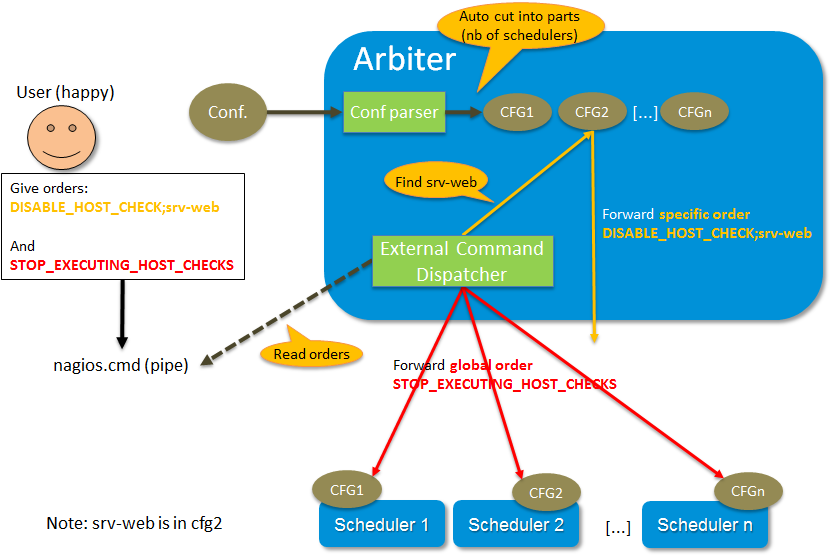
The user can send external commands to the system to raise a downtime or send a passive check. The commands should be sent to the only daemon that orchestrates everything in the system: the Arbiter. It gives it the external commands (in a name pipe or with a webservice) and the Arbiter sends it to whoever needs it (just one scheduler or all of them).
It looks like this:
Via the Receiver daemon
External commands can also be sent to the receivers daemons. They will bufferize all commands, and each second the arbiter will connect to the receivers and will grab the commands. Then the previous arbiter behavior is launched.
Via the Livestatus API
The Livestatus API is a Broker daemon module. It listens to the network for data requests or external commands. Commands can be authenticated. Commands can be submitted via a Python interface or a JSON interface. Consult the MK Livestatus documentation for the supported parameters.